If you had told a software engineer in 2023 that by 2026, over 85% of all production-grade code would be authored, tested, or refactored by artificial intelligence, they might have laughed you out of the room. Yet, here we are. According to the 2026 Global Developer Report, the “human-only” codebase has officially become a relic of the past.
The landscape of software development has shifted from a manual craft to a high-level orchestration. We are no longer just “coders” fighting with syntax; we are architects of intelligence. As AI coding tools have evolved from simple autocomplete plugins to autonomous software agents, the day-to-day life of a developer has changed forever.
1. From Autocomplete to Autonomous Agents
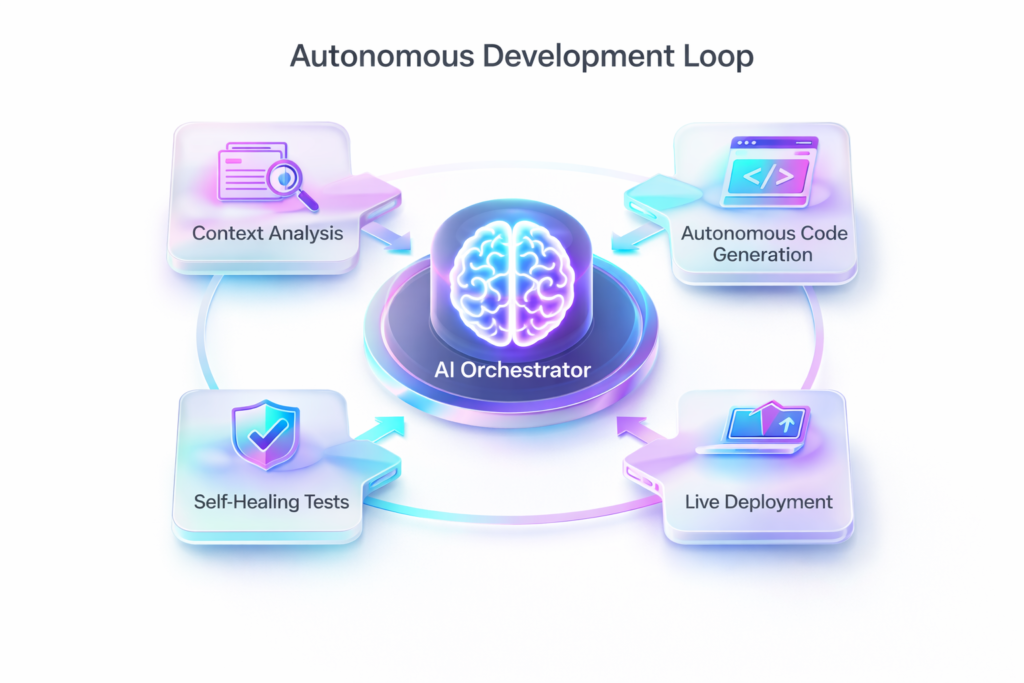
In the early 2020s, platforms like GitHub Copilot were essentially “Tab-to-complete” features. They were helpful but required constant supervision. Fast forward to 2026, and the industry has transitioned to Autonomous Development Agents. These modern AI coding tools possess “system-wide context.” They don’t just look at the file you’re currently editing; they understand your entire repository, your CI/CD pipelines, and even your Jira tickets. Today, you can give an agent a high-level task—like “Add a multi-factor authentication flow using OIDC”—and it will create the components, set up the backend logic, and update the documentation across the entire project without manual intervention.
2. Instant Legacy Code Modernization
One of the most profound changes in 2026 is how we handle legacy systems. The “monolith” is no longer a death sentence for a company’s agility. Modern AI coding tools can ingest 20-year-old COBOL or ancient Java code and refactor it into modern, cloud-native Rust or Go in a matter of hours. This has allowed enterprises to eliminate decades of technical debt that previously cost millions to manage, freeing up budgets for actual innovation rather than just “keeping the lights on.”
3. Self-Healing CI/CD Pipelines
The dreaded “Build Failed” notification is becoming a thing of the past. When a pipeline breaks today, the AI agent analyzes the logs, identifies the logic error or dependency conflict, and automatically submits a Pull Request (PR) with the fix. This self-healing infrastructure means that DevOps teams are no longer woken up at 3:00 AM for minor deployment hitches. Human developers now spend their time approving fixes rather than hunting for broken semicolons.
4. Natural Language to Full-Stack (Text-to-App)
The barrier to entry for software creation has collapsed. We have reached the era of “Text-to-App.” Product managers and designers can now describe a feature in plain English, and AI coding tools generate a functional frontend, a connected database schema, and the necessary serverless functions. While senior engineers are still needed to oversee complex logic, the “boilerplate” phase of starting a new project has been reduced from weeks to seconds.
5. Synthetic Persona Testing
Testing has moved far beyond simple unit tests. In 2026, AI now generates “Synthetic Personas”—virtual users with diverse, unpredictable behaviors—that hammer an application to find edge-case bugs. These AI coding tools simulate thousands of user interactions simultaneously, catching 99% of UI/UX friction points and race conditions before a single real user ever sees the product. This has made software more stable than at any point in history.
6. Real-Time Documentation and Knowledge Graphs
Documentation used to be the bane of every developer’s existence. In 2026, AI coding tools maintain a live “Knowledge Graph” of your codebase. As code is written, documentation is updated instantly. More importantly, new developers can “chat” with the codebase. Instead of reading a 50-page wiki, a new hire can ask, “Why did we choose this specific caching strategy in 2024?” and the AI will explain the architectural decision based on historical commits and Slack discussions.
7. AI-Powered Peer Review
The “Senior Developer” bottleneck has finally eased. AI models, fine-tuned on billions of high-quality commits, now perform the first layer of code reviews. They catch security flaws, style inconsistencies, and performance bottlenecks before a human ever looks at the PR. This ensures that when a human developer finally reviews the code, they can focus on high-level logic and business impact rather than minor syntax choices.
8. Hyper-Personalized Dev Environments
Every developer’s IDE is now unique to them. Modern AI coding tools learn your specific coding style, your favorite libraries, and even your common logic gaps. The IDE adapts its interface and suggestions to fill those gaps, effectively acting as a permanent, personalized pair-programmer. If you struggle with CSS Grid but excel at backend logic, the AI provides more robust styling assistance while staying out of your way during API construction.
9. Context-Aware Security Auditing
Security is no longer a final step in the SDLC; it is baked into the first keystroke. Modern AI coding tools monitor for “Shadow Code”—bits of AI-generated logic that might be functional but mathematically obscure. They cross-reference every package against global vulnerability databases in real-time. By the time you hit “Save,” the code has already been scanned for compliance with GDPR, SOC2, and internal security protocols.
10. Predictive Maintenance for Software
Just like industrial machinery, software now has predictive maintenance. AI coding tools monitor application performance in production and predict when a database will scale inefficiently or when a memory leak is likely to occur based on current coding patterns. The system prompts developers to refactor specific modules before a crash happens, moving the industry from reactive bug-fixing to proactive system health management.
The Rise of the “Product Engineer”: Why Syntax is Secondary
In 2026, the human developer is finally free to focus on the “why.” Engineering is becoming a discipline of design thinking rather than rote memorization. Because modern AI coding tools handle the “how” (the syntax, the boilerplate, the API integrations), the human role has shifted toward “Context Engineering.”
It is no longer about writing the perfect prompt. It is about knowing how to structure the data, business constraints, and user needs so that the AI delivers a scalable solution. As syntax becomes a commodity, your value lies in your ability to see the “Big Picture”—ensuring the overarching architecture is resilient, ethical, and aligned with the user’s ultimate goals.
Security and the AI-Driven Vulnerability Loop
It’s not all sunshine and automated deployments. As AI coding tools become more prevalent, the cat-and-mouse game of cybersecurity has reached a fever pitch. While AI is excellent at spotting common vulnerabilities, it has also made it easier for malicious actors to generate sophisticated, polymorphic malware.
To stay relevant, developers must now master AI Governance. This involves ensuring that the AI tools used within an organization are not leaking proprietary logic into public training sets. Organizations are now implementing “Air-Gapped AI” models to protect their intellectual property while still reaping the productivity benefits of machine-authored code.
Key Takeaways
- Embrace Autonomy: Stop using AI as a simple search engine; integrate autonomous agents that can fix bugs and manage your CI/CD pipelines.
- Prioritize System Design: Your primary value in 2026 is your ability to architect systems. Let the AI coding tools handle the granular implementation.
- Kill Technical Debt: Leverage AI-driven modernization tools to refactor legacy stacks into modern, high-performance languages like Rust or Go.
- Security by Design: Use real-time AI auditing to catch both human and machine-generated vulnerabilities the moment they are written.
- Cultivate Agility: The tools are evolving faster than ever. A “perpetual learner” mindset is now more important than being a master of any single programming language.
Leave a Reply