The Reliability Factor (Ghosting vs. Continuity)
Many business owners experience the same pain: work begins, deadlines slip, and suddenly communication fades. Emails slow. Messages get ignored. The freelancer disappears — sometimes due to burnout, emergencies, or better opportunities. When a single person is responsible, the entire project halts if they fall sick, take a vacation, or lose interest. “Ghosting” is not a rare phenomenon. It’s a structural risk.
Agencies function differently. At Code Nest, the model is built on redundancy. Designers, developers, and QA specialists overlap in responsibilities. If one team member becomes unavailable, another steps in. Workflow doesn’t collapse when a single individual leaves or pauses. The processes, documentation, and internal knowledge base ensure continuity. That matters, especially for business-critical websites — eCommerce, SaaS, booking platforms, and lead-generation sites where downtime means revenue loss.
A freelancer offers flexibility. An agency offers reliability. And reliability directly translates into reduced operational risk.
The “Jack of All Trades” Myth
Many freelancers brand themselves as full-stack designers, SEO strategists, UX architects, and cybersecurity specialists. The claim sounds impressive. The reality is different. Web development spans multiple disciplines:
- UI and UX design
- Frontend and backend development
- Database architecture
- SEO optimization
- Mobile responsiveness
- Accessibility standards
- Security and penetration testing
- Performance tuning
- Maintenance and upgrades
Mastery across all domains within one individual is rare. Learning one area deeply takes years. Attempting all often results in surface-level knowledge. For hobby websites or landing pages, this might work. For revenue-driven platforms, it becomes a liability.
An agency divides responsibilities. Designers design. Developers code. Security specialists handle vulnerabilities. Content strategists optimize SEO. Each role has depth rather than breadth.
This teamwork produces more polished outputs:
- Cleaner architecture
- Consistent branding
- Scalable code
- Better UX
- Search-ready content
When comparing hiring digital agency vs freelancer, a key advantage of an agency is expertise segmentation. Specialists working together outperform generalists working alone, especially when the project demands high performance and long-term evolution.
Scalability and Long-Term Growth
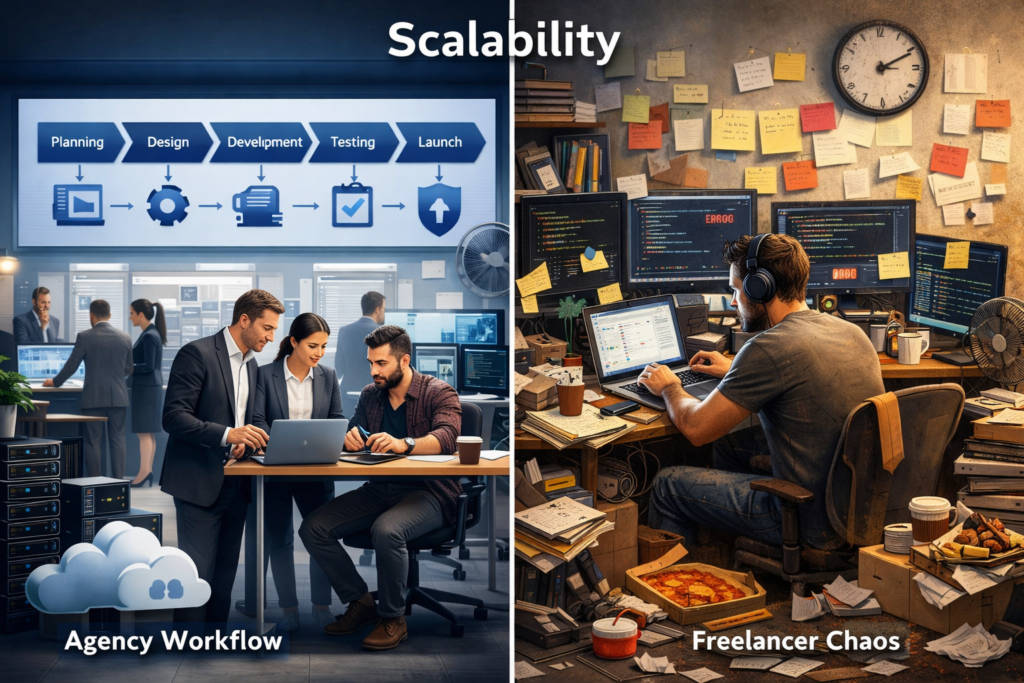
A website isn’t finished when the launch button is clicked. Businesses evolve. Features get added. Integrations change. Traffic increases. Security threats adapt. Google updates ranking signals. If a website is built without scalability in mind, the owner pays later.
Freelancers often structure code around fast delivery. Quick fixes. Framework shortcuts. Minimal documentation. They do this to keep pricing low and timelines short — a necessary approach for solo work. But fast delivery today can create technical debt tomorrow.
Two years later, the same freelancer may be unavailable. They could be working full-time elsewhere. They might have changed tech stacks. Or lost access to files. You’re left with code no one understands.
Digital agencies document:
- architecture
- dependencies
- credentials
- version controls
- deployment steps
- design systems
This ensures longevity. A different developer can step in and continue without guesswork.
Scalability matters for:
- new features
- user traffic spikes
- mobile variation
- third-party integrations
- payment systems
- analytics platforms
Businesses planning for growth avoid brittle builds. Agencies support that objective through structured development, documentation, and maintenance plans.
The Cost Comparison (Upfront vs. Total Cost of Ownership)
Freelancers win the upfront cost battle. Lower pricing. Minimal overhead. Faster negotiations. For micro-budgets, this is appealing.
But cost analysis in business is not about initial payment. It’s about total cost of ownership.
Common hidden expenses with freelancer-driven projects:
- Rewriting poorly structured code
- Fixing bugs after launch
- Paying a second developer to complete abandoned work
- Delays causing missed marketing cycles
- Security patches after a breach
- SEO rewrites due to weak on-page structure
- Performance optimization for slow loading
Cheap development can become expensive maintenance.
Agencies charge more at the onset. They deliver:
- planning
- documentation
- QA testing
- scalable architecture
- support packages
- secure deployments
The result is longer asset lifespan and fewer unexpected expenses.
For revenue-driven sites, agencies reduce risk and lower long-term cost.
When to Choose Which? (The Verdict)
There are scenarios where freelancers make sense. There are scenarios where they don’t. The choice depends on stakes, complexity, and business goals.
Freelancer is suitable when:
- The budget is extremely limited
- The project is a portfolio, blog, or hobby site
- Speed is more important than scalability
- You accept higher risk for lower cost
- A small MVP demo is needed for testing
Agency delivers better value when:
- The website supports sales or client acquisition
- eCommerce or payment systems are required
- Security is a priority
- Future scaling is expected
- You need ongoing maintenance and support
- Brand consistency and UX impact revenue
- Delays or downtime carry financial consequences
When the website is core to business operations, treating development as a low-cost task is dangerous. Agencies protect your investment by delivering structured, stable, and scalable solutions — a critical factor in the agency vs freelancer for business debate.
The Bottom Line
The argument isn’t emotional. It’s operational. Freelancers reduce starting costs. Agencies reduce long-term risk. Businesses must choose based on objectives, not only budgets.
A freelancer can deliver a simple, functional, attractive website quickly. A digital agency builds a platform capable of supporting growth, integration, scaling, and maintenance. The difference becomes clear when traffic rises, new features are required, or support is needed urgently.
When evaluating hiring digital agency vs freelancer, the safest choice for revenue-centric businesses is the partner capable of continuity, specialization, and long-term support.
Soft CTA
If your business depends on its website — for leads, sales, or credibility — contact Code Nest. Get a secure, scalable, fully documented build supported by a professional team rather than a single point of failure.
Leave a Reply