Core Web Vitals INP, mobile-first indexing, schema markup benefits, website architecture for SEO, javascript SEO
Introduction
The era of trying to game Google with keyword repetition is gone. AI-driven search systems no longer reward pages just because they mention a phrase twelve times. They reward pages that function flawlessly.
A website is a house. Keywords are the paint. Technical SEO is the foundation. You can repaint endlessly, but if the structure is cracked, the house collapses. In 2025, this analogy has become reality. Google’s ranking systems—reinforced by AI Overviews, UX signals, and quality scoring—prioritize page experience, code stability, and system health before even considering your text.
This is why the technical SEO checklist 2025 matters more than any keyword strategy you’ve used before.
Core Web Vitals Are Now the Law (Not Suggestions)
Google’s Core Web Vitals used to be performance recommendations. In 2025, they dictate visibility. If a site consistently fails them, rankings drop aggressively.
The three metrics that matter:
LCP (Largest Contentful Paint) — Measures how fast the main content appears. If your hero section takes too long, users bounce before they even read the headline.
INP (Interaction to Next Paint) — This replaced FID and is now the most important interaction metric. It measures how fast the page responds when a user taps, clicks, or types. If a button visually reacts late, users feel the site is broken.
CLS (Cumulative Layout Shift) — Tracks visual instability. If elements jump while loading, the site feels unreliable.
Google has made it clear with AI Overviews and UX-first ranking models: If you fail these, you don’t rank. Period.
The shift is logical. As AI answers more queries directly, Google prioritizes sending users only to sites that offer frictionless interaction. Slow loading, lagging buttons, and shifting layouts are treated as trust violations.
Crawl Budget & Architecture: Helping the Bot
Crawl Budget is the number of URLs Googlebot is willing to inspect within a timeframe. Most businesses unnecessarily waste it.
Google doesn’t have unlimited time to understand your website. If your structure is chaotic, pages load slowly, or internal linking is broken, the bot simply stops crawling.
A technically healthy site has:
A clean architecture with pages organized in silos
Logical URL hierarchy
No orphan pages (pages with zero internal links)
Consistent navigation paths
No duplicated content generated by sloppy development
Wasted crawl budget means:
Important pages may never get indexed
New content takes longer to rank
Updates are ignored for days or weeks
Messy code amplifies this problem. When the bot encounters unnecessarily large scripts, infinite scroll traps, or recursive redirects, it abandons the crawl. Businesses blame keywords, but the culprit is usually architecture failure.
Speaking “Robot Language” With Schema Markup
Schema markup is structured data that translates your content so AI systems can understand context immediately. It is the difference between Google knowing your page is about “Custom Software Development” versus simply guessing.
Schema powers:
Rich snippets (stars, FAQs, product prices)
AI Overview visibility
Enhanced click-through rates
Better understanding of services, authors, reviews, and business details
In 2025, Schema has become a core ranking component. Without it, your content is “linguistically flat” to search engines. AI Overviews heavily rely on contextual data, and structured data is the fastest signal.
For modern SEO, Schema is not optional. It’s the language your website must speak if it wants Google to trust it.
The JavaScript SEO Problem
JavaScript frameworks dominate modern development, but most developers still deploy them poorly.
React, Angular, and Vue apps render content on the client side. Googlebot can technically render JavaScript, but it does so slowly and with limitations. Many JS-heavy websites show blank pages during the first crawl.
This is where Code Nest sees the biggest technical failures.
Examples:
Dev teams ship React SPAs with no Server-Side Rendering (SSR).
Content loads only after multiple asynchronous calls.
Routing is virtual, leaving bots unable to map pages.
Heavy JS bundles delay interaction and inflate INP values.
When Google hits a blank container instead of real content, the page is treated as low-value.
The solution: Use frameworks like Next.js, which handle SSR and static generation correctly. This ensures:
Google sees the full HTML instantly
Content is indexable
Speed metrics improve
AI Overviews can extract accurate information
JavaScript SEO in 2025 is a technical discipline, not an afterthought.
The 2025 Technical SEO Checklist (5 Critical Items)
A high-performing website meets these standards consistently.
1. Verify SSL and Security Headers
HTTPS only
HSTS enabled
No mixed content Security is now a ranking trust signal.
Lazy-load non-critical media Images remain a top contributor to slow LCP.
5. Review robots.txt and XML Sitemaps
Ensure bots can access key pages
Remove outdated disallows
Keep sitemaps clean and up to date
A clear bot path dramatically improves indexing efficiency.
Conclusion
Producing more content cannot fix a broken infrastructure. A website with weak performance, chaotic architecture, or unreadable JavaScript is invisible—no matter how many keywords you target.
Technical SEO has become the determining factor in organic visibility for 2025. Not because keywords are irrelevant, but because Google’s AI systems need technically sound platforms to deliver reliable search experiences.
If your site feels slow, unstable, or inconsistent, Google quietly moves on to a competitor.
Stop guessing. Let Code Nest run a deep-dive Technical Audit on your site today.
Traffic but no sales? Learn why your conversion rate is low. We analyze intent mismatch, slow load speeds, and weak CTAs to fix your revenue leaks.
Seeing analytics numbers go up but revenue stay flat is frustrating. Many business owners assume they need more traffic, but traffic doesn’t fix a broken conversion system. It magnifies the problem. Think of traffic as water. Your website is the bucket. If the bucket has holes, adding more water only drains faster.
This is a conversion issue, not a traffic shortage. Effective website conversion rate optimization starts with identifying why users visit and leave without taking action. When the funnel leaks, leads evaporate, sales stall, and ad spend becomes wasteful.
The “Intent vs. Reality” Mismatch (Relevance)
Visitors click because they expect something specific. If the landing page content doesn’t match that expectation, the disconnect triggers an immediate exit. For example, an ad offering Custom App Development should not send users to a generic IT services homepage. The gap between promise and delivery destroys trust before the scroll.
A misaligned headline is one of the biggest causes of page abandonment. The brain seeks confirmation quickly. If it doesn’t see it within seconds, it rejects the page as irrelevant.
Actionable Fix: Align your ad copy and headline. If your ad states: “Custom Shopify Store in 10 Days”
Your H1 should read: Custom Shopify Store Delivered in 10 Days — Guaranteed
Relevance reduces cognitive load. Matching language reinforces intent. This simple alignment alone can improve landing page conversion without increasing traffic.
Friction: The Silent Killer (Speed & Mobile)
Friction destroys momentum. Slow loading, clunky navigation, and awkward mobile forms introduce resistance. Users bail quickly. A 3-second delay increases bounce rate by roughly 40%, and the longer it extends, the more catastrophic the fallout.
Core Web Vitals matter—especially for revenue pages. They aren’t just SEO metrics. They reflect user patience thresholds.
Mobile adds another layer. If a user must pinch-zoom to read text or struggle with a form that has tiny fields, conversion collapses. They abandon—not because they aren’t interested—but because the effort required feels unreasonable.
Actionable Fixes:
Compress images and leverage lazy loading
Eliminate intrusive pop-ups on mobile
Make forms thumb-friendly with large fields and fewer required inputs
Reduce bounce rate by stripping friction, not adding more persuasive copy. Speed and comfort convert better than clever wording.
Your Call to Action (CTA) Is Confusing
A CTA is a decision point. Ambiguity increases hesitation. Buttons that read “Learn More” or “Submit” offer no clarity or value. They communicate effort without reward. Users refrain from clicking because they don’t know what happens next.
Another issue is clutter. Multiple CTAs scattered across a page compete for attention. Choice paralysis kicks in. Visitors freeze. When everything is important, nothing is.
Effective CTAs are:
action-oriented
expectation-setting
benefit-driven
Compare:
Submit vs Get Your Free Audit
Learn More vs See Pricing & Timeline
Clarity isn’t optional. It’s psychological guidance. Limit one primary CTA per section. Position it where intent peaks—after value propositions, not before.
Lack of Social Proof (Trust Deficit)
Visitors don’t trust easily. They evaluate credibility rapidly, and absence of proof triggers skepticism. Without third-party validation, claims look self-serving. Social proof bridges doubt with reassurance.
Necessary trust signals include:
real testimonials with full names
case studies with quantifiable results
recognizable partnership or client logos
industry certifications
media mentions
A testimonial saying “They were great to work with” is weak. One stating “Reduced our cost per lead by 34% in 90 days” is persuasive. Vagueness reads fabricated. Specificity reads authentic.
Place social proof near CTAs—not buried in footers. Users seek reassurance at decision moments, not after scrolling to the end.
Feature Bloat vs. Benefit Clarity
Businesses often brag about features, tools, frameworks, and internal processes. Users don’t care initially. They care about outcomes. Listing Next.js, React, Node, AWS means little to a CFO whose priority is speed, uptime, and revenue.
Features speak to you. Benefits speak to the customer.
Examples: We use Next.js → Your site loads instantly and keeps visitors engaged We provide 256-bit SSL → Your customers feel safe entering payment details
Benefits anchor value. Features support credibility. In that order.
Remove jargon from top-level messaging. Engineers care about stack details. Decision-makers care about impact. When benefits lead, conversion follows.
The Real Reason Traffic Doesn’t Fix This
Traffic amplifies your site’s strengths or weaknesses. If the page leaks leads due to misalignment, friction, confusion, or mistrust:
More traffic = more leaks
More ad spend = more waste
More users = more abandonment
Imagine pouring more water into a bucket riddled with holes. Marketers tell you to increase the flow. Strategists tell you to fix the leaks first.
A workshop analogy: You can bring 1,000 customers into a store—but if shelves are unorganized and the cashier line is slow, sales are limited. The problem isn’t footfall. It’s friction.
Conversion optimization turns existing traffic into revenue without increasing cost. It transforms marketing from expense to investment.
CRO Fixes Deliver the Highest ROI
Conversion improvements outperform traffic increases in efficiency and cost.
Examples of high-impact adjustments:
rewriting headlines for intent alignment
compressing media to reduce load time
simplifying CTAs and reducing choice overload
placing social proof near decision triggers
converting features to benefit language
shortening forms
applying mobile-first layouts
using heatmaps to detect friction
These actions repair leaks before scaling. Website conversion rate optimization ensures ad spend translates into leads, not bounces. It rescues wasted budget and increases lifetime value.
Summary & Soft Pitch
Traffic without conversion is noise—vanity metrics masking revenue inefficiency. Fixing conversion yields more return than buying more clicks. When the bucket stops leaking, every dollar spent fills it rather than draining out.
Stop assuming traffic is the cure. Diagnose leaks. Patch friction. Align intent. Present value clearly. Build trust. Then scale.
Stop guessing. Contact Code Nest for a UX/UI Audit today.
Image Prompts for This Blog
“A leaky bucket metaphor: website represented as a bucket with holes leaking water labeled traffic, professional business tone, conversion optimization concept, detailed, analytical visual style.”
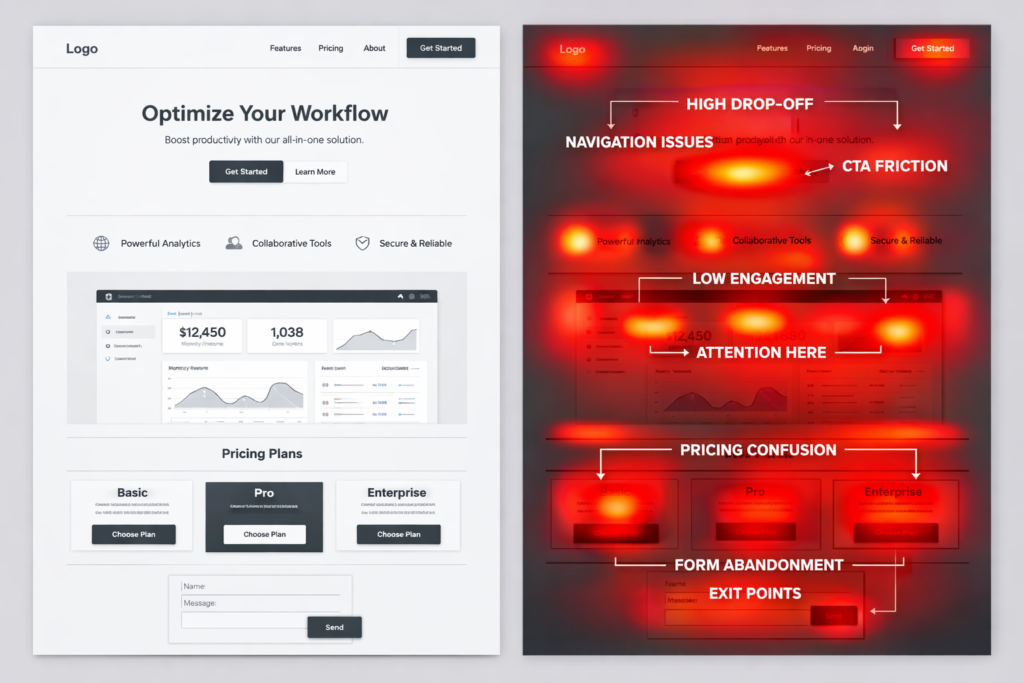
“Split screen heatmap analysis on a landing page showing red hot zones of friction and user drop-offs, corporate UI/UX audit theme, clean and clinical design.”
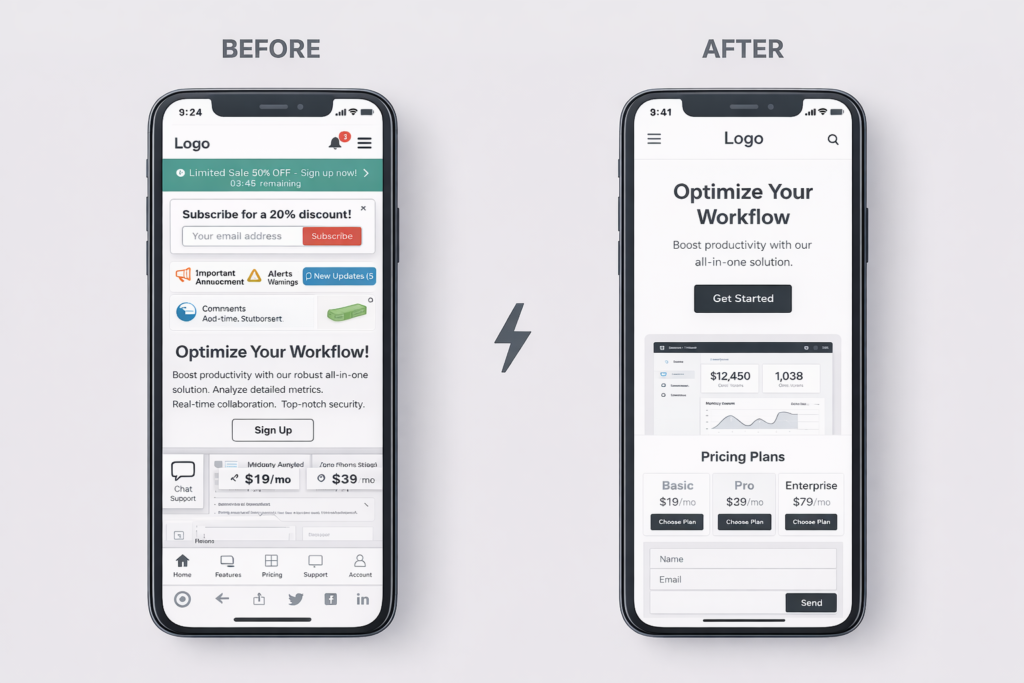
“Before and after website comparison: slow cluttered mobile site vs clean fast optimized version, CRO-focused, business aesthetic, minimalistic and high detail.”
Many business owners experience the same pain: work begins, deadlines slip, and suddenly communication fades. Emails slow. Messages get ignored. The freelancer disappears — sometimes due to burnout, emergencies, or better opportunities. When a single person is responsible, the entire project halts if they fall sick, take a vacation, or lose interest. “Ghosting” is not a rare phenomenon. It’s a structural risk.
Agencies function differently. At Code Nest, the model is built on redundancy. Designers, developers, and QA specialists overlap in responsibilities. If one team member becomes unavailable, another steps in. Workflow doesn’t collapse when a single individual leaves or pauses. The processes, documentation, and internal knowledge base ensure continuity. That matters, especially for business-critical websites — eCommerce, SaaS, booking platforms, and lead-generation sites where downtime means revenue loss.
A freelancer offers flexibility. An agency offers reliability. And reliability directly translates into reduced operational risk.
The “Jack of All Trades” Myth
Many freelancers brand themselves as full-stack designers, SEO strategists, UX architects, and cybersecurity specialists. The claim sounds impressive. The reality is different. Web development spans multiple disciplines:
UI and UX design
Frontend and backend development
Database architecture
SEO optimization
Mobile responsiveness
Accessibility standards
Security and penetration testing
Performance tuning
Maintenance and upgrades
Mastery across all domains within one individual is rare. Learning one area deeply takes years. Attempting all often results in surface-level knowledge. For hobby websites or landing pages, this might work. For revenue-driven platforms, it becomes a liability.
An agency divides responsibilities. Designers design. Developers code. Security specialists handle vulnerabilities. Content strategists optimize SEO. Each role has depth rather than breadth.
This teamwork produces more polished outputs:
Cleaner architecture
Consistent branding
Scalable code
Better UX
Search-ready content
When comparing hiring digital agency vs freelancer, a key advantage of an agency is expertise segmentation. Specialists working together outperform generalists working alone, especially when the project demands high performance and long-term evolution.
Scalability and Long-Term Growth
A website isn’t finished when the launch button is clicked. Businesses evolve. Features get added. Integrations change. Traffic increases. Security threats adapt. Google updates ranking signals. If a website is built without scalability in mind, the owner pays later.
Freelancers often structure code around fast delivery. Quick fixes. Framework shortcuts. Minimal documentation. They do this to keep pricing low and timelines short — a necessary approach for solo work. But fast delivery today can create technical debt tomorrow.
Two years later, the same freelancer may be unavailable. They could be working full-time elsewhere. They might have changed tech stacks. Or lost access to files. You’re left with code no one understands.
Digital agencies document:
architecture
dependencies
credentials
version controls
deployment steps
design systems
This ensures longevity. A different developer can step in and continue without guesswork.
Scalability matters for:
new features
user traffic spikes
mobile variation
third-party integrations
payment systems
analytics platforms
Businesses planning for growth avoid brittle builds. Agencies support that objective through structured development, documentation, and maintenance plans.
The Cost Comparison (Upfront vs. Total Cost of Ownership)
Freelancers win the upfront cost battle. Lower pricing. Minimal overhead. Faster negotiations. For micro-budgets, this is appealing.
But cost analysis in business is not about initial payment. It’s about total cost of ownership.
Common hidden expenses with freelancer-driven projects:
Rewriting poorly structured code
Fixing bugs after launch
Paying a second developer to complete abandoned work
Delays causing missed marketing cycles
Security patches after a breach
SEO rewrites due to weak on-page structure
Performance optimization for slow loading
Cheap development can become expensive maintenance.
Agencies charge more at the onset. They deliver:
planning
documentation
QA testing
scalable architecture
support packages
secure deployments
The result is longer asset lifespan and fewer unexpected expenses.
For revenue-driven sites, agencies reduce risk and lower long-term cost.
When to Choose Which? (The Verdict)
There are scenarios where freelancers make sense. There are scenarios where they don’t. The choice depends on stakes, complexity, and business goals.
Freelancer is suitable when:
The budget is extremely limited
The project is a portfolio, blog, or hobby site
Speed is more important than scalability
You accept higher risk for lower cost
A small MVP demo is needed for testing
Agency delivers better value when:
The website supports sales or client acquisition
eCommerce or payment systems are required
Security is a priority
Future scaling is expected
You need ongoing maintenance and support
Brand consistency and UX impact revenue
Delays or downtime carry financial consequences
When the website is core to business operations, treating development as a low-cost task is dangerous. Agencies protect your investment by delivering structured, stable, and scalable solutions — a critical factor in the agency vs freelancer for business debate.
The Bottom Line
The argument isn’t emotional. It’s operational. Freelancers reduce starting costs. Agencies reduce long-term risk. Businesses must choose based on objectives, not only budgets.
A freelancer can deliver a simple, functional, attractive website quickly. A digital agency builds a platform capable of supporting growth, integration, scaling, and maintenance. The difference becomes clear when traffic rises, new features are required, or support is needed urgently.
When evaluating hiring digital agency vs freelancer, the safest choice for revenue-centric businesses is the partner capable of continuity, specialization, and long-term support.
Soft CTA
If your business depends on its website — for leads, sales, or credibility — contact Code Nest. Get a secure, scalable, fully documented build supported by a professional team rather than a single point of failure.
In today’s digital-first economy, a website is no longer optional for small businesses—it is the foundation of growth. Yet many businesses still rely on outdated, slow, or poorly structured websites that fail to convert visitors into customers. A high-converting website is not about design alone; it is about strategy, performance, and clarity.
Your Website Is Your First Salesperson
For most potential customers, your website is the first interaction with your brand. Before they call, email, or visit your store, they judge credibility within seconds. A professional website builds trust instantly, while a cluttered or slow site pushes visitors away—often permanently.
A high-converting website clearly answers three questions:
What do you offer?
Why should someone choose you?
What should they do next?
If these answers are not immediately obvious, conversions drop.
Speed and Performance Drive Results
Website speed directly impacts user behavior and search rankings. Studies consistently show that users abandon websites that take more than a few seconds to load. Beyond user experience, search engines reward fast, optimized websites with better visibility.
A conversion-focused website is built with:
Optimized images and code
Clean structure and mobile responsiveness
Reliable hosting and security measures
Performance is not a technical luxury—it is a revenue driver.
Design That Guides, Not Distracts
Good design is invisible. It guides users smoothly toward action without overwhelming them. Strategic use of white space, readable typography, and clear calls-to-action ensures visitors know exactly where to click and what to do.
High-converting websites avoid:
Excessive animations
Confusing navigation
Generic stock messaging
Instead, they focus on clarity, hierarchy, and intent.
SEO Brings the Right Traffic
A website that converts well but receives no traffic still fails to deliver value. Search engine optimization ensures your business appears when potential customers actively search for your services.
SEO-driven websites are built with:
Proper heading structures
Location-focused content
Fast loading and mobile compatibility
Clean URLs and internal linking
This combination attracts qualified traffic—users already looking for solutions you provide.
Conversion Is a Process, Not a Feature
Many businesses assume adding a contact form is enough. In reality, conversion optimization is a process that includes messaging, layout, trust signals, and analytics. Testimonials, guarantees, and clear service explanations all reduce friction and increase confidence.
When executed correctly, a website becomes a predictable lead-generation system.
Final Thoughts
A high-converting website is one of the most valuable assets a small business can own. It works 24/7, builds trust at scale, and turns visitors into paying customers. In 2025, businesses that invest in performance-driven websites will consistently outperform those that do not.
At Code Nest, we build websites with one goal in mind: growth.
Data orchestration refers to the automated process of managing, integrating, and transforming data from various sources into a streamlined workflow. In today’s digital landscape, businesses generate vast amounts of data from a plethora of sources, including databases, cloud services, and third-party applications. Managing this diverse data efficiently is paramount, as it drives critical decision-making processes and underpins operational efficiency.
The significance of data orchestration in data management cannot be overstated. By creating a cohesive framework for data processing, orchestration enhances data accessibility and quality, ensuring that analytics and reporting activities rely on consistent data. Moreover, it mitigates the risks associated with manual processes, such as errors and delays, while promoting scalability in data operations.
Automation is a pivotal aspect of data orchestration, providing the tools necessary to orchestrate complex data pipelines seamlessly. Through automation, businesses can design workflows that automatically move data between systems, aggregate information, and apply transformations without human intervention. This not only saves time but also allows data teams to focus on more strategic tasks rather than the manual handling of data.
As organizations increasingly adopt cloud-based services and a variety of data storage solutions, the need for effective orchestration becomes even more pronounced. The complexity of managing multiple data sources necessitates a robust orchestration framework. This framework helps streamline data workflows, enabling organizations to extract maximum value from their data assets. By understanding the foundational concepts of data orchestration, including its definition, importance, and integration with automation, readers will be better equipped to appreciate its role in modern data management strategies.
The Importance of Data Automation
In the current data-driven landscape, organizations face an increasing demand for efficient data management. Automating data pipelines is a crucial strategy that allows businesses to streamline their operations and enhance decision-making processes. One of the primary benefits of data automation is the significant reduction in manual intervention. By minimizing human involvement in data processing tasks, organizations not only save valuable time but also reduce the likelihood of errors that can occur during manual handling.
Increased efficiency is another compelling reason to implement data automation. Automated pipelines can process vast amounts of data much faster than manual methods, thereby accelerating the flow of information to end-users. This leads to a quicker time-to-insight, enabling organizations to respond promptly to changing business conditions and customer needs. For instance, companies that implement automated solutions can easily analyze market trends or customer behaviors in near real-time, which aids in making informed strategic decisions.
The ability to scale operations seamlessly is also a notable advantage of automating data pipelines. As businesses grow, their data requirements become more complex. Automated systems can efficiently handle increased data volumes without a proportional increase in operational costs, making them suitable for organizations of all sizes. Real-world examples abound; companies like Netflix and Airbnb utilize data automation to manage their extensive data operations, allowing them to focus on innovation rather than getting bogged down by manual processes.
Moreover, automation in data management fosters a culture of continuous improvement. With reliable data as the foundation, organizations can leverage insights to refine their processes, ultimately driving business value. In conclusion, automation of data pipelines is not merely a trend; it is an essential practice for any competitive organization in today’s fast-paced market.
Key Components of a Data Pipeline
A data pipeline is a crucial framework that enables organizations to effectively manage and utilize their data flows. The essential elements of a data pipeline include data ingestion, data transformation, and data storage, each of which plays a significant role in ensuring the seamless orchestration of data from its source to its ultimate destination.
Data ingestion is the first step in the data pipeline process. This component is responsible for collecting raw data from various sources, which can include databases, APIs, and even streaming data. The technologies employed in this phase can range from simple file uploads to more sophisticated tools like Apache Kafka and AWS Kinesis, which facilitate real-time data streaming. Effective data ingestion ensures that data is captured reliably and is readily available for further processing.
Following data ingestion, the next pivotal stage is data transformation. In this component, raw data is processed and converted into a usable format. This can involve a variety of actions, such as cleaning, aggregating, and enriching the data. By applying transformation techniques, organizations can derive insightful metrics and business intelligence from the raw data. Common technologies for this phase include Apache Spark and Talend, which provide robust capabilities for complex data manipulations.
Finally, data storage is the last key element in the data pipeline. After the data has been ingested and transformed, it needs to be stored securely in a structured format that allows for easy access and analysis. Modern solutions often utilize cloud storage services like Amazon S3, Google Cloud Storage, or traditional database systems such as PostgreSQL and MongoDB. Each of these technologies plays a vital role in ensuring that the data remains accessible and organized for future analytics.
Collectively, these components create a coherent pipeline that enhances the efficiency of data management, facilitating informed decision-making within organizations.
Challenges in Data Orchestration
Organizations encounter various challenges when implementing data orchestration, impacting their ability to effectively automate data pipelines and utilize data-driven insights. One primary issue is the existence of data silos, which hinder the seamless flow of information across departments. These silos can stem from unique departmental systems or legacy architectures, making it difficult to achieve a unified view of data. Consequently, organizations struggle to leverage their datasets for holistic insights, leading to inefficiencies in decision-making processes.
Another challenge lies in the complexities of data integration. With the proliferation of diverse sources, such as cloud services, on-premise databases, and third-party applications, organizations face a daunting task in harmonizing these multiple data streams. Establishing robust integrations between various systems often requires significant time and resources, exacerbating existing operational bottlenecks and delaying critical insights.
Latency issues present an additional challenge, particularly in time-sensitive environments where real-time data processing is essential. High latency can result from inadequate infrastructure or inefficient data handling processes, thereby reducing the timely availability of insights necessary for informed decision-making. Organizations must invest in optimizing their data pipelines to mitigate these latency concerns.
Furthermore, the skills gap represents a significant hurdle in the field of data orchestration. There is often a scarcity of qualified professionals who possess the technical acumen to effectively manage and orchestrate complex data systems. This shortage can lead to reliance on outdated practices or insufficient automation, ultimately hindering the overall effectiveness of data orchestration initiatives.
Techniques for Automating Data Pipelines
Data orchestration is critical for ensuring the seamless flow of information across various systems and applications. As organizations increasingly rely on data-driven decision-making, automating data pipelines has become a necessity rather than a luxury. Several techniques have emerged that aid in the automation of data pipelines and enhance their efficiency.
One of the primary techniques involves the use of orchestration frameworks. For instance, Apache Airflow has gained popularity due to its flexible architecture that allows for the scheduling and monitoring of workflows. By utilizing Directed Acyclic Graphs (DAGs), Airflow enables users to define complex dependencies between tasks, ensuring a coherent pipeline execution. The platform supports various backends and offers a range of integrations with data sources.
Another notable framework is AWS Step Functions, which simplifies the coordination of distributed applications and microservices. This service offers the benefit of serverless architecture, allowing organizations to focus on their applications rather than infrastructure management. It provides a visual interface to design workflows, makes error handling intuitive, and allows for easy integration with other AWS services.
Google Cloud Dataflow also stands out as a powerful tool for data pipeline automation. It facilitates the processing of both batch and streaming data and automatically optimizes resource allocation. With its ability to scale both horizontally and vertically, users can manage large volumes of data efficiently. The integration with Google’s ecosystem ensures that companies can utilize advanced analytics and machine learning capabilities directly on their datasets.
Beyond these frameworks, various other tools like Apache NiFi and Luigi provide options for automating data flows. Each of these tools has its strengths and weaknesses depending on specific use cases and organizational needs. By evaluating these various techniques and platforms, businesses can choose the right solutions to optimize their data pipelines effectively.
Best Practices for Successful Data Orchestration
Successful data orchestration initiatives are critical for organizations seeking to optimize their data pipeline and improve decision-making. Establishing clear data governance policies is one of the foremost practices to consider. This involves defining roles, responsibilities, and procedures regarding data management which helps ensure consistency and compliance across all data handling processes.
In addition to governance, ensuring data quality is paramount. High-quality data is foundational to any data orchestration effort, as inaccurate or inconsistent data can lead to faulty analytics and misguided business decisions. Employing data validation techniques, regular audits, and monitoring tools can assist in maintaining the integrity of data throughout its lifecycle, thus enhancing trust in automated processes.
Monitoring pipeline performance is another crucial aspect. Organizations should implement comprehensive monitoring frameworks that provide insights into data flow, processing times, and system performance. Key performance indicators (KPIs) should be established to assess the efficiency of the data orchestration system, enabling teams to react proactively to bottlenecks or failures in the pipeline.
Flexibility to adapt to changing business needs is also essential for successful data orchestration. The business landscape is constantly evolving, and data requirements may change as new objectives arise. Organizations should adopt orchestration solutions that allow for easy modifications to workflows and processes without extensive re-engineering – this adaptability can significantly enhance the longevity and relevance of the data orchestration initiative.
In conclusion, adhering to best practices such as clear governance, commitment to data quality, continuous monitoring, and maintaining flexibility will facilitate successful data orchestration. Implementing these strategies can lead to heightened operational efficiency and improved decision-making capabilities within organizations.
Real-World Applications of Data Orchestration
Data orchestration plays a pivotal role across various industries, streamlining processes and enhancing data management capabilities. One notable application is within the healthcare sector. Organizations are increasingly relying on data orchestration to integrate disparate data sources, such as electronic health records (EHRs), laboratory results, and billing systems. By automating these data pipelines, healthcare providers achieve improved patient care outcomes and operational efficiency through accurate, real-time data availability.
In the retail industry, companies are also leveraging data orchestration to optimize their supply chain operations. For instance, a major retail organization implemented orchestration tools to automate inventory tracking and demand forecasting. This significantly reduced stockouts and excess inventory, allowing the retailer to respond more effectively to customer needs while minimizing costs.
Moreover, the financial services industry utilizes data orchestration to enhance risk management and compliance processes. A leading bank adopted orchestration frameworks to automatically retrieve and process transaction data, enabling real-time detection of fraudulent activities. This proactive approach not only increased security but also reduced operational burdens on compliance teams.
Additionally, organizations in the manufacturing sector benefit from data orchestration by ensuring smoother production workflows. For example, a manufacturing firm utilized orchestration tools to connect its machinery, inventory systems, and workforce scheduling applications. This integration allowed for timely adjustments to production schedules based on real-time data, ultimately improving efficiency and reducing downtime.
In conclusion, the diverse applications of data orchestration across various sectors demonstrate its utility in automating data pipelines. By fostering enhanced collaboration and integration of data sources, organizations can drive meaningful business outcomes and adapt to the ever-evolving market landscape.
Future Trends in Data Orchestration
The landscape of data orchestration is poised for significant evolution, driven by advancements in artificial intelligence (AI) and machine learning (ML). These technologies are becoming integral to automating data workflows, enabling organizations to derive insights more efficiently. AI and ML can optimize data pipelines by predicting and resolving issues proactively, ensuring seamless data integration and transformation processes. Such capabilities not only enhance operational efficiency but also reduce downtime, allowing businesses to respond rapidly to changing data demands.
Another notable trend in data orchestration is the advent of serverless architectures. This approach eliminates the need for managing infrastructure, allowing companies to focus on building scalable data pipelines without the overhead associated with traditional server management. Serverless computing enables automatic scaling and reduces costs by allowing organizations to pay only for the compute time they actually use. Consequently, this can greatly improve the efficiency and cost-effectiveness of data orchestration strategies, streamlining how data is processed and managed across platforms.
The shift towards cloud-native data solutions is further shaping the future of data orchestration. As more organizations migrate to cloud environments, there is an increasing demand for orchestration tools that are designed to operate seamlessly within these settings. Cloud-native solutions offer enhanced flexibility, scalability, and integration with various data services, leading to more robust orchestration capabilities. These tools can leverage multi-cloud strategies, facilitating data movement and processing across different environments, which is crucial for organizations looking to optimize their data ecosystems.
Conclusion and Next Steps
In summary, the landscape of data orchestration is becoming increasingly vital for organizations aiming to automate their data pipelines efficiently. The ability to streamline data flows, integrate various sources seamlessly, and enhance overall data governance is essential for maintaining a competitive edge in today’s data-driven environment. The key takeaways from this article emphasize the importance of adopting robust data orchestration strategies that encompass not just the tools employed but also the methodologies used to manage data across the enterprise.
Organizations should recognize the urgency of implementing data orchestration practices that align with their business objectives. As the demand for real-time data analytics surges, it becomes imperative to prioritize the development of automation capabilities. One actionable step is to assess the current data pipeline architecture and identify bottlenecks and inefficiencies that may hinder data processing and analysis.
Furthermore, training initiatives should be established to enhance team expertise in data orchestration technologies. By investing in staff training, organizations can equip employees with the necessary skills to manage and optimize automated data workflows effectively. Participating in workshops or obtaining certifications in relevant tools can also provide deeper insights into best practices within the domain.
Trialing different automation tools can lead to informed decisions about which platforms best suit the organization’s needs. It may be beneficial to implement a pilot project that leverages data orchestration solutions to evaluate their impact on existing workflows before rolling out full-scale operations.
Finally, organizations should develop a strategic roadmap for the implementation of data orchestration solutions. This roadmap should outline specific goals, timelines, and necessary resources, ensuring a structured approach to adopting automation. By taking these steps, businesses can better position themselves to leverage the full potential of their data and drive innovation across their operations.
Cybersecurity refers to the practice of protecting systems, networks, and programs from digital attacks aimed at accessing, altering, or destroying sensitive information, or disrupting normal operational processes. It is a field that has gained undeniable importance in an increasingly digital world, where personal, governmental, and corporate data are constantly at risk due to various cyber threats.
At its core, cybersecurity encompasses a variety of strategies, technologies, and practices designed to safeguard electronic assets. The purpose of cybersecurity is to maintain the confidentiality, integrity, and availability of information, ensuring that data remains secure from unauthorized access and potential breaches. A major aspect of this field involves understanding the types of cyber threats that exist today, including malware, phishing, and ransomware, among others.
Vulnerabilities represent weaknesses in systems or networks that can be exploited by cybercriminals to gain access to sensitive data. Identifying these vulnerabilities is crucial for developing effective cybersecurity measures. One useful framework for understanding how attacks occur is the cyber kill chain, which is a model that outlines the stages of a cyber attack, from initial reconnaissance to execution and ultimately, goal completion. Awareness of these phases supports organizations in creating stronger defenses and implementing strategic responses.
As technology advances, the cybersecurity landscape continues to evolve, presenting new challenges and necessitating the development of robust security measures. The increasing reliance on digital connectivity, coupled with the sophistication of cyber threats, underscores the significance of cybersecurity as an integral element in safeguarding information and maintaining trust in technology-driven platforms.
The Rise of Cyber Threats
The digital landscape has witnessed an alarming increase in the frequency and sophistication of cyber threats over the past decade. With the rapid advancement of technology, malicious actors have adapted and developed more intricate methods to exploit vulnerabilities. Cybersecurity measures are of paramount importance as organizations and individuals face a myriad of threats including phishing, ransomware, and Distributed Denial of Service (DDoS) attacks.
Phishing attacks, one of the most common cyber threats, have evolved drastically, using social engineering tactics to deceive users into divulging sensitive information such as passwords and credit card numbers. Through the use of seemingly legitimate emails or messages, attackers lure individuals to fraudulent websites. According to a recent report, phishing incidents have surged, accounting for 30% of all reported cyber threats in the last year alone.
Ransomware, another significant concern, has transformed into a growing epidemic. This form of malicious software encrypts a victim’s data, rendering it inaccessible until a ransom is paid. The global impact of ransomware attacks has been staggering, with estimates indicating that businesses worldwide lost over $20 billion in 2020 due to these incidents. Notable attacks, such as the Colonial Pipeline incident, have underscored the operational disruptions and financial repercussions that can arise from such security breaches.
Additionally, DDoS attacks target the availability of services by overwhelming servers with excessive traffic, resulting in system downtime. These attacks have also intensified, further highlighted by a reported increase of over 400% in DDoS incidents within the last two years. The implications of these escalated threats are profound, affecting not only businesses but also government and healthcare sectors, making robust cybersecurity strategies a critical necessity.
Impact of Cyber Attacks on Individuals and Businesses
Cyber attacks have severe implications that extend beyond immediate technical disruptions, affecting both individual users and organizations. The financial losses incurred from these security breaches can be substantial. Individuals may experience direct theft from personal accounts or extensive costs associated with credit monitoring and recovery services following identity theft. For businesses, the monetary impact can include immediate remediation costs and long-term losses due to operational downtime, loss of customers, and diminished market share.
Reputational damage is another profound consequence of cyber attacks. For individuals, having personal information exposed can lead to significant personal distress and anxiety. Organizations, however, often face a harsh escalation of this issue, as customers may lose trust in brands known for poor data protection measures. This erosion of confidence can lead to decreased sales figures and a tarnished brand image in a competitive marketplace.
Legal implications arise from cyber attacks, further complicating the aftermath. Individuals might find themselves dealing with legal intricacies in efforts to reclaim stolen identities or recover lost funds. For businesses, the repercussions can involve litigation from affected customers or regulatory penalties for failing to comply with data protection laws, such as the General Data Protection Regulation (GDPR). This legal scrutiny can incur heavy fines and possibly prompt investigations into their cybersecurity practices.
Moreover, the emotional toll is often overlooked yet highly significant. Victims of cyber attacks may suffer from anxiety, stress, and a sense of vulnerability following the incident. In a corporate context, employees may face increased pressure and diminished morale, particularly if a cyber attack leads to layoffs or downsizing. Collectively, these impacts illustrate how critical it is for individuals and organizations to prioritize cybersecurity measures to mitigate potential fallout from cyber threats.
Key Principles of Cybersecurity
Cybersecurity is built on several fundamental principles that ensure the protection of sensitive information and systems. The most widely recognized framework is the CIA triad, which consists of three core principles: confidentiality, integrity, and availability. Each principle plays a critical role in safeguarding information against unauthorized access, manipulation, and disruption.
Confidentiality refers to ensuring that only authorized individuals have access to specific data. This is achieved using various methods such as encryption, access control, and authentication mechanisms. By applying these methods, organizations can effectively limit access to sensitive information, thereby mitigating the risk of data breaches and unauthorized disclosures.
Integrity represents the accuracy and reliability of data. Maintaining data integrity involves ensuring that information is not altered or tampered with, either unintentionally or maliciously. Organizations implement data validation, checksums, and version control systems to protect against data corruption and unauthorized modifications. Such measures help maintain a trustworthy information environment, which is essential for decision-making processes and operational efficiency.
Availability ensures that information and resources are accessible to users when required. This involves implementing systems and processes that prevent service disruptions, whether due to cyberattacks or technical failures. Organizations deploy backup solutions, redundancy techniques, and incident response protocols to minimize downtime and ensure continued access to critical services and data.
When these three principles—confidentiality, integrity, and availability—are effectively implemented, they contribute significantly to a robust cybersecurity posture. Organizations must continually assess and adapt their cybersecurity measures to address emerging threats and technologies, making the CIA triad essential not only in theory but also in practice. Ultimately, understanding and adhering to these core principles is vital for maintaining the security and trustworthiness of information systems in an increasingly digitized world.
Best Practices for Protecting Yourself Online
In an increasingly digital world, understanding how to protect oneself online is paramount. Individuals can enhance their personal cybersecurity by implementing several best practices. One of the most critical steps is creating strong, unique passwords for different accounts. A robust password should typically consist of at least 12 characters, incorporating upper and lower case letters, numbers, and special symbols. Additionally, it is advisable to use a password manager to store and generate complex passwords, reducing the risk of reuse and theft.
Recognizing phishing attempts is another essential skill in safeguarding online activities. Phishing often occurs through email or messages masquerading as trustworthy entities to extract sensitive information. Users should be cautious of unsolicited communications that request personal information or contain links to unfamiliar websites. Verifying the sender’s email address and scrutinizing the message’s content is vital before taking any action.
Utilizing two-factor authentication (2FA) adds an additional layer of security to accounts. This method requires not only a password but also a second factor, such as a text message or authentication app verification, to access accounts. Enabling 2FA drastically reduces the risk of unauthorized access, even if a password is compromised.
Moreover, regularly updating software and applications is crucial for personal cybersecurity. Software developers frequently release patches and updates to address vulnerabilities that could be exploited by cybercriminals. Users should enable automatic updates whenever possible and regularly check for updates on all devices.
By adopting these best practices, individuals can significantly enhance their online safety and mitigate the risk of cyber threats, thus creating a more secure digital environment for themselves and their sensitive information.
Cybersecurity in the Corporate World
In today’s digital age, cybersecurity is a critical concern for organizations across all sectors. Businesses increasingly rely on digital assets for their operations, making them prime targets for cyber threats. A robust cybersecurity framework is vital to protect sensitive data, maintain customer trust, and ensure compliance with regulations. Establishing a comprehensive cybersecurity policy is the cornerstone of an organization’s defense strategy.
A well-defined cybersecurity policy outlines the acceptable use of technology and information systems within the organization. This includes guidelines for protecting sensitive information, incident response protocols, and roles and responsibilities of employees regarding security practices. Moreover, having a cybersecurity policy helps organizations in creating a culture of security awareness among employees, which is essential for preventing data breaches.
Employee training plays a significant role in the overall cybersecurity posture of a company. Regular training sessions equip employees with the knowledge to recognize potential threats such as phishing attacks and social engineering tactics. The objective is to foster a proactive approach where employees are not just passive users of technology but active participants in safeguarding organizational assets. Furthermore, simulated cyber-attacks can be beneficial in preparing employees to handle real-life scenarios effectively.
The implementation of modern security technologies is another crucial aspect of cybersecurity in the corporate world. Organizations must invest in tools such as firewalls, intrusion detection systems, and encryption technologies to bolster their defenses. These technologies work in conjunction with established policies and trained staff to create a multi-layered security approach. By integrating advanced security solutions with human oversight, companies can significantly reduce their vulnerability to cyber threats.
The Role of Government and Legislation in Cybersecurity
Governments around the world play a pivotal role in shaping the landscape of cybersecurity through the establishment of legislation, regulations, and national strategies. With the rise of cyber threats, governments have recognized the need to protect sensitive information and critical infrastructure from malicious actors. This has led to the formulation of various laws aimed at enhancing cybersecurity measures and promoting public safety.
One of the key aspects of governmental involvement in cybersecurity is the development of comprehensive legislation. For instance, many countries have introduced data protection laws that regulate how organizations collect, store, and process personal data. These laws not only hold organizations accountable for potential breaches but also empower citizens by granting them rights over their own data. A prime example is the General Data Protection Regulation (GDPR) implemented by the European Union, which has established stringent guidelines for data handling and privacy.
In addition to legislation, various government agencies have been tasked with fostering cybersecurity practices. Agencies such as the Cybersecurity and Infrastructure Security Agency (CISA) in the United States play a crucial role in coordinating efforts between public and private sectors to bolster national cybersecurity. These agencies often provide resources, training, and tools to help organizations enhance their security posture against evolving threats.
Moreover, governments are increasingly focusing on international collaboration to address cybersecurity challenges that transcend borders. Through multilateral agreements and frameworks, nations can share intelligence and best practices, making it easier to combat cybercrime and protect the global information infrastructure.
Given the rapid pace of technological advancement, it is essential for governments to continuously adapt their legislative measures and strategies to address emerging threats. This proactive approach can significantly contribute to a safer digital environment, ultimately safeguarding both economies and individuals from potential cyber risks.
Emerging Cybersecurity Trends and Technologies
The field of cybersecurity is constantly evolving, driven by new technologies and the ever-changing landscape of cyber threats. One of the most significant trends in recent years is the increasing use of artificial intelligence (AI) and machine learning in cybersecurity measures. These technologies are being leveraged to enhance threat detection, automate responses, and improve overall security posture. AI algorithms can analyze vast amounts of data to identify patterns and anomalies that may indicate potential security breaches, allowing organizations to respond more swiftly and effectively than traditional methods.
Machine learning, a subset of AI, plays a crucial role in developing adaptive security solutions. As it learns from previous attack vectors and response outcomes, it continuously refines its detection capabilities. This adaptability is vital in combating sophisticated attacks that constantly evolve to bypass standard security protocols. Furthermore, AI-driven systems can help manage the overwhelming volume of alerts generated by security tools, prioritizing the most critical threats and reducing the burden on cybersecurity teams.
Additionally, the cybersecurity landscape is seeing a significant democratization of security technologies. Small and medium-sized enterprises now have access to advanced cybersecurity tools that were once only available to large organizations. Cloud-based security solutions offer scalability and affordability, allowing these businesses to deploy effective security measures without extensive on-premises infrastructure.
Moreover, the rise of the Internet of Things (IoT) presents new challenges and opportunities in the realm of cybersecurity. The proliferation of connected devices increases the attack surface, necessitating innovative security solutions to protect sensitive data transmitted across these devices. Cybersecurity experts are focusing on developing advanced encryption methods and establishing better protocols for device authentication to mitigate risks associated with IoT.
In conclusion, staying abreast of these emerging trends and technologies is crucial for organizations aiming to strengthen their cybersecurity measures. By integrating AI, machine learning, and innovative security solutions, organizations can better prepare for the complexities of future cyber threats.
Conclusion: The Future of Cybersecurity
The landscape of cybersecurity is ever-evolving, driven by advancements in technology and the corresponding rise of sophisticated cyber threats. As organizations become increasingly reliant on digital infrastructure, the significance of cybersecurity cannot be overstated. Addressing the challenges of cybersecurity necessitates a proactive approach, emphasizing the need for continuous vigilance and adaptation to counteract emerging threats.
One of the primary challenges in the field of cybersecurity is the rapid pace of technological change. With the proliferation of the Internet of Things (IoT), data analytics, and artificial intelligence, new vulnerabilities emerge that can be exploited by cybercriminals. Enterprises must commit to staying ahead of these trends, ensuring that their cybersecurity strategies evolve in conjunction with technological advancements. This means not only implementing cutting-edge security solutions but also routinely updating them to patch known vulnerabilities.
Further complicating the cybersecurity landscape is the increasing sophistication of cyberattacks. Hackers are employing more advanced techniques, making it critical for organizations to develop a strong defense posture that includes behavioral analytics and threat intelligence. Investing in staff training and awareness programs can empower teams to identify potential threats before they manifest into significant breaches.
Moreover, as regulations surrounding data protection continue to tighten, organizations must also remain compliant with the latest legislative demands. This compliance is not merely about avoiding penalties but rather about restoring trust in the digital ecosystem. Transparent communication with customers regarding how their data is secured can differentiate a business in the competitive marketplace.
In conclusion, the future of cybersecurity will require a multifaceted approach that prioritizes innovation, preparedness, and compliance. By establishing a culture of cybersecurity awareness, organizations can create a resilient framework to withstand the ever-changing landscape of cyber threats.