
The era of “Black Box” AI is coming to an abrupt end. If you’ve spent the last three years paying OpenAI for a locked-down API, you’ve likely noticed a seismic shift in the developer community. According to recent 2025 industry trackers, open-source model downloads on Hugging Face have skyrocketed by over 300% year-over-year, outpacing the growth of proprietary API registrations for the first time in history.
The narrative that you need a multi-billion dollar closed model to achieve state-of-the-art results has been thoroughly debunked. From Meta’s relentless engineering to the efficiency breakthroughs coming out of France and Asia, open weights are no longer just for hobbyists—they are now outperforming GPT-4 in specific, critical benchmarks.
But why are developers migrating in droves? And which models actually deserve a place in your production stack? Let’s dive into the seven titans of open-source AI in 2026.
1. Meta’s Llama 3: The Heavyweight Champion
If you follow the “AI Wars,” the primary battleground in 2026 is undoubtedly Llama 3 vs GPT-4. Meta has effectively become the “Red Hat” of AI, providing a foundation that rivals the biggest names in the business.
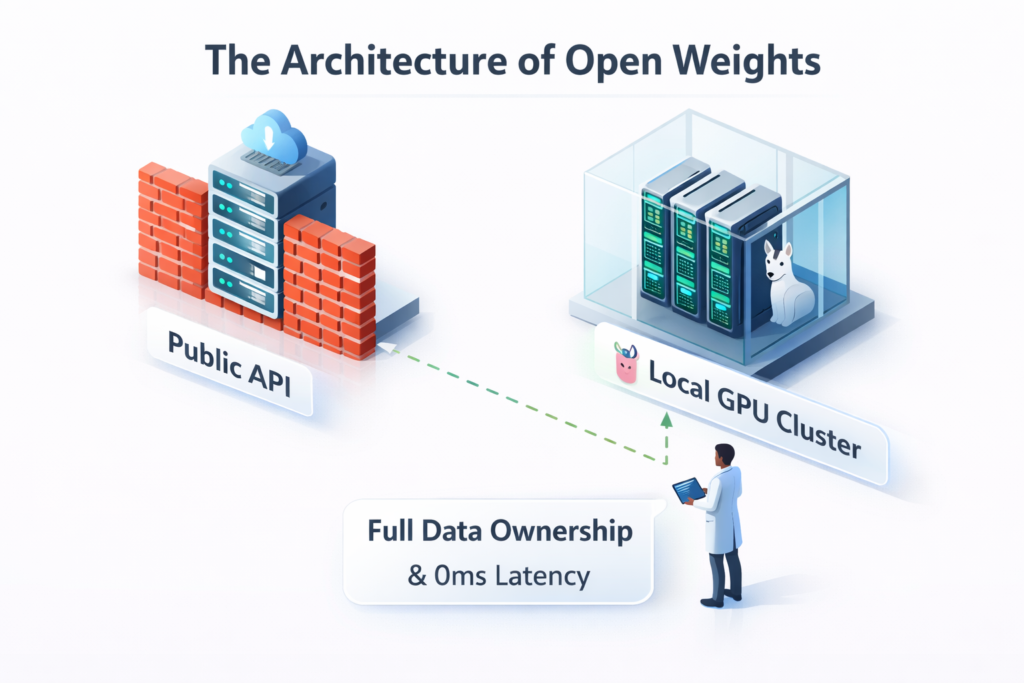
Llama 3 (particularly the 405B and the rumored 500B+ variations) has closed the reasoning gap. While GPT-4 remains a versatile generalist, Llama 3 offers something OpenAI cannot: sovereignty. Companies can now host Llama 3 on their own private H100 or Blackwell clusters, ensuring that not a single byte of customer data ever touches an external server.
Why it beats ChatGPT: In specialized coding tasks and mathematical reasoning, Llama 3 often scores within 1–2 percentage points of GPT-4, but at a fraction of the cost per token when self-hosted.
2. Mistral & Mixtral: The European Efficiency King
Coming from Paris-based Mistral AI, the Mixtral “Mixture of Experts” (MoE) architecture revolutionized how we think about compute. Mixtral 8x22B doesn’t run every parameter for every word; it intelligently “routs” tasks to the most efficient part of the brain.
In 2026, Mistral’s models are the go-to for low-latency applications. While ChatGPT can sometimes lag or produce “preachy” moralizing content, Mistral is leaner, more modular, and incredibly easy to fine-tune for niche industrial applications like automated legal document review or medical coding.
3. Grok-2: The Massive Context and Real-Time Hybrid
Elon Musk’s xAI recently open-sourced Grok-2’s weights, sending shockwaves through the industry. What sets Grok-2 apart from the ChatGPT interface is its native integration with real-time data flows.
Grok-2’s training set included massive amounts of real-world dialogue and technical data, making it particularly adept at understanding contemporary events. While GPT-4 often suffers from “knowledge cut-offs,” the open-source community has paired Grok-2 with advanced RAG (Retrieval-Augmented Generation) systems that make it a formidable rival for real-time news analysis and trend forecasting.
4. DeepSeek-V3: The Silent Assassin from Asia
If you want to know which model provides the best “bang for your buck,” look toward DeepSeek. By 2026, DeepSeek-V3 has become the darling of the startup world. Its performance-per-token is arguably the highest in the market.
DeepSeek excels in technical disciplines. In benchmarks involving competitive programming and deep mathematics, DeepSeek-V3 has frequently outclassed GPT-4 Turbo. Its open-source nature has allowed for a “Specialist” ecosystem to thrive, where thousands of fine-tuned versions for Python, Rust, and Go are available for free.
5. Falcon 2 (TII): The Sovereign King
Developed by the Technology Innovation Institute (TII) in Abu Dhabi, the Falcon 2 series represents the peak of data-cleansing quality. Falcon’s team didn’t just scrape the internet; they curated a high-quality “RefinedWeb” dataset.
In terms of Zero-shot reasoning, Falcon 2 holds its own against GPT-4, but it shines most in international and multilingual environments. For businesses operating across the Middle East, Europe, and Asia, Falcon offers linguistic nuances that US-centric models like ChatGPT often miss.
6. Qwen 2.5: The New Frontier of Coding
Alibaba’s Qwen series has transitioned from a localized favorite to a global powerhouse. In the coding world, Qwen 2.5 is often preferred over GPT-4 by those building high-frequency trading bots or complex backend architectures.
The search intent behind most developer queries recently is “How to self-host a coding LLM.” Qwen 2.5 is the answer. It handles complex, long-form logic chains with fewer hallucinations than OpenAI’s flagship models, making it the perfect “Agentic” partner for autonomous software development.
7. OLMo: The Truly Transparent Model
While Llama 3 is “open weights,” the Allen Institute for AI’s OLMo (Open Language Model) is truly open-source. This means the researchers released not just the model, but the training data, the logs, and the evaluation suite.
For organizations in highly regulated industries like Healthcare and Defense, OLMo is the gold standard for Auditable AI. When every decision a model makes must be traceably linked to its training data to prevent bias and ensure safety, OLMo beats the closed-off architecture of ChatGPT every single time.
Search Intent: Why Is Open Source Finally Winning?
Google users are no longer asking “What is a chatbot?” They are now asking specific, ROI-driven questions:
- Is it cheaper to host Llama 3 or use the GPT-4 API? (Answer: At high volume, self-hosting is 60–80% cheaper).
- Which AI model is best for privacy? (Answer: Any open-source model running on your VPC).
- Llama 3 vs GPT-4 benchmarks: In 2026, the delta is so small that the advantages of customization and zero-latency in open-source often outweigh the slight reasoning edge of GPT-4.
The Verdict: When Should You Switch?
The move from ChatGPT to an open-source alternative depends on your “Moat.”
If you are just writing social media captions, ChatGPT is fine. But if you are building a product where the AI is the core infrastructure, you cannot build your castle on rented land. Open-source models allow you to “own” your intelligence, fine-tune it on your secret internal data, and scale without worrying about OpenAI’s rate limits or pricing changes.
Key Takeaways
- The Power Gap is Closed: In 2026, models like Llama 3 and DeepSeek-V3 match or exceed GPT-4 in coding and technical reasoning.
- Data Sovereignty is Non-Negotiable: Open source is the only way for enterprises to ensure 100% data privacy and security.
- Cost Efficiency: High-volume token usage is significantly cheaper via self-hosting open-source weights on specialized hardware (NVIDIA Blackwell/AMD Instinct).
- The “Agentic” Future: Open models are easier to integrate into autonomous workflows and “Agent” frameworks due to lower latency and API flexibility.
- Mistral and Qwen are the top picks for efficiency and multilingual technical support, respectively.
Leave a Reply