
If your IT department feels like a crowded airport terminal—full of frustrated travelers waiting for flights that are perpetually delayed—you aren’t alone. In early 2024, industry leaders predicted a shift, but in 2026, the data confirms a total metamorphosis. According to the latest Gartner Magic Quadrant analysis, over 75% of new application development is now powered by Low-Code and No-Code (LCNC) platforms, up from less than 25% just five years ago.
The era of the “technical gatekeeper” has officially ended. We are no longer living in a world where a marketing manager has to wait six months for a simple lead-gen dashboard or a basic internal inventory tool. By leveraging no-code development, businesses are decentralizing innovation and turning every employee with a logic-driven mind into a potential builder.
But what does this actually mean for the traditional software engineer? Is the “Product Engineer” becoming obsolete, or are we witnessing the greatest liberation of technical talent in history? Here is how low-code/no-code platforms are fundamentally restructuring the modern tech team.
1. The End of the “Death-By-Backlog” Culture
The most significant search intent for IT managers today revolves around one word: Throughput. Historically, developers spent 40% to 60% of their time on “grunt work”—writing repetitive CRUD (Create, Read, Update, Delete) operations, setting up boilerplate authentication, and styling CSS buttons for internal tools that only five people use.
No-code development has nuked that backlog. By shifting the burden of internal tooling and basic app architecture onto LCNC platforms like FlutterFlow, Mendix, or Bubble, organizations have effectively cleared the decks for their “Pro-code” teams.
In 2026, a “High-Authority Tech Team” isn’t measured by how many lines of code they ship, but by how little “low-value” code they have to touch. Developers have transitioned from “doers of all things” to “enablers of the platform,” focusing their brainpower on high-complexity challenges like algorithmic optimization, database scaling, and proprietary AI integration.
2. The Citizen Developer Phenomenon: Scaling Innovation without Headcount
A question frequently asked on Google is: “Who can use no-code?” The answer is the Citizen Developer. These are subject-matter experts—Accountants, Project Managers, and HR Specialists—who understand the business logic better than any external coder could.
When you provide a Marketing Operations specialist with a no-code environment, you eliminate the “Lost in Translation” phase of the development lifecycle.
- Reduced Friction: There is no need for a 50-page requirements document. The person who has the problem is the person who builds the solution.
- Rapid Iteration: In a no-code development environment, a “v1” can be built and deployed in an afternoon. If it doesn’t work, it’s discarded with zero “sunk cost” in engineering hours.
- Agile Reality: This is the true fulfillment of the Agile Manifesto—functional software over comprehensive documentation.
For the tech team, the “Citizen Developer” isn’t a threat; they are a force multiplier. Instead of hiring 10 more junior developers, CTOs are now hiring “No-Code Leads” to train existing staff on these platforms.
3. Hybrid Workflows: When “Pro-Code” Meets “No-Code”
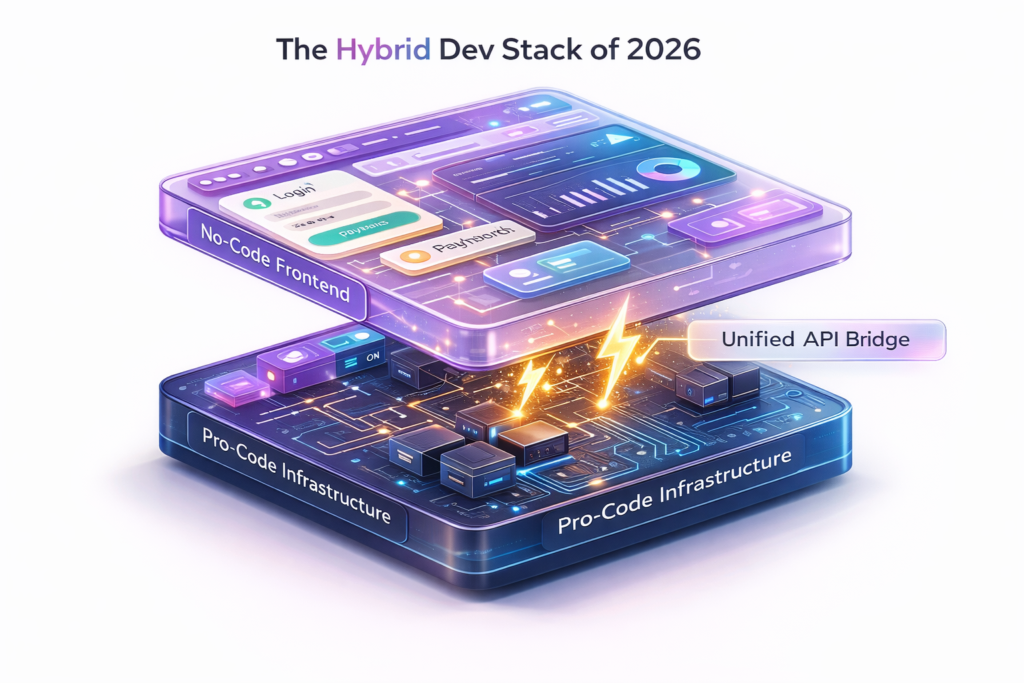
One of the most complex concepts for teams to grasp is how to integrate these tools into an existing CI/CD (Continuous Integration/Continuous Deployment) pipeline. This is where Hybrid Development comes in.
In 2026, the “Golden Stack” looks like this:
- The No-Code Frontend: Marketing or Ops builds the UI and basic workflows.
- The API Layer: This bridges the no-code frontend to the legacy systems.
- The Pro-Code Backend: Professional engineers build specialized microservices in Go, Rust, or Python that the no-code app “calls” when things get heavy.
This “Headless No-Code” approach allows for extreme speed at the interface level without compromising the architectural integrity of the system. It allows teams to “hack” the user experience while keeping the data layer strictly governed by engineering standards.
4. Addressing the Search Intent: Is No-Code Security a Myth?
The number one fear regarding no-code development (and a high-volume search query) is: “Is no-code secure?”
In 2024, “Shadow IT” was the bogeyman—the idea that employees would build insecure apps that leaked company data. By 2026, the leading LCNC platforms have solved this through Enterprise Governance Layers.
Modern tech teams are using LCNC tools that offer:
- RBAC (Role-Based Access Control): Centralized IT can decide exactly which “Citizen Developer” has access to which data silos.
- Automated Auditing: Unlike custom code, which requires manual security audits, LCNC platforms generate “auditable” blocks. You can see every logic step visually, making it easier to spot security flaws than scanning 10,000 lines of spaghetti code.
- Compliance-by-Design: Many platforms now bake HIPAA, GDPR, and SOC2 compliance into the drag-and-drop components themselves.
Instead of trying to stop people from building, modern IT departments are creating “Paved Paths”—pre-approved no-code environments where business units are free to innovate within a safe, sandboxed playground.
5. The Search Intent FAQ: Is Software Engineering Dead?
Let’s answer the question every junior developer is asking Google: “Will no-code replace my job?”
The short answer: No. The long answer: It will change your job description.
The demand for high-level engineers has actually increased because of no-code. As companies build more apps with no-code development, the complexity of the connections between those apps grows exponentially.
- The “System Orchestrator”: We need engineers who can weave 50 different no-code apps into a unified, high-performance ecosystem.
- The “Custom Component” Creator: No-code platforms eventually hit a limit. We need “Pro-Coders” to build the custom widgets, advanced APIs, and heavy-duty logic that doesn’t exist in a template.
If you are a developer in 2026, your value isn’t your ability to write a for-loop. Your value is your ability to understand system architecture.
Conclusion: A Culture of Digital Sovereignty
The transformation of tech teams through LCNC platforms is ultimately a move toward Digital Sovereignty. It breaks down the silo between “the people who think” and “the people who build.”
By adopting no-code development, tech teams are evolving from “cost centers” to “enablement hubs.” They aren’t just shipping software anymore; they are shipping the tools that allow the rest of the company to ship their own software. This shift doesn’t just make the company faster; it makes the company smarter.
The future of software is inclusive, visual, and rapid. Are you building with it, or are you still waiting in the backlog?
Key Takeaways
- Massive Efficiency: LCNC platforms reduce development time by up to 70%, allowing developers to focus on high-logic architecture.
- Empowered Staff: Citizen Developers can solve their own business problems without clogging the IT pipeline.
- Governance Over Control: Modern tech teams don’t “block” development; they provide secure “No-Code Sandboxes” for business units.
- Hybrid Success: The best tech stacks in 2026 combine no-code flexibility with pro-code stability.
- Career Pivot: Software Engineering isn’t dying; it is evolving into Platform Orchestration and high-level architectural design.
Leave a Reply