For a business owner or product manager, the “Native vs. Cross-Platform” debate is one of the most consequential decisions you will make. It isn’t just a technical preference for your developers; it is a strategic business decision that dictates your budget, your time-to-market, and the long-term maintainability of your product.
The central question is simple: Should you build two separate apps (one for iOS and one for Android) using the specific languages of those platforms, or should you build one app that runs on both?
While the idea of “writing once and running everywhere” sounds like a financial no-brainer, the reality is more nuanced. At Code Nest, we help clients navigate this choice by looking past the hype and focusing on the specific performance requirements and user experience goals of their project.
Understanding Native Development: The Custom-Tailored Suit
Native development involves writing code specifically for a single platform. For iOS, this means using Swift; for Android, it means using Kotlin or Java.
Think of a Native app like a custom-tailored suit. It is designed precisely for the measurements of the wearer. Because the app is built using the tools provided by Apple or Google themselves, it has direct access to the device’s hardware—the camera, GPS, sensors, and processor—without any “middleman.”
The Strengths of Native
- Ultimate Performance: For apps that require heavy processing, such as high-end gaming, AR/VR, or complex video editing, Native is the only choice. It offers the smoothest animations and the fastest load times.
- Platform-Specific UI: Every platform has its own design language. Native apps feel “at home” on their respective devices because they use standard system components.
- Immediate Feature Access: When Apple or Google releases a new feature (like Dynamic Island or advanced haptics), Native developers can implement it on day one.
The Business Downside
The cost is the primary barrier. Building Native means hiring two separate teams (or paying one team twice as long) to build the same features twice. It also means maintaining two separate codebases for the life of the product.
The Rise of Cross-Platform: Flutter and React Native

Cross-Platform development allows developers to write one codebase that renders on both iOS and Android. In recent years, this technology has matured to the point where, for 90% of business applications, the user cannot tell the difference between a cross-platform app and a native one.
When we talk about flutter vs react native vs native, we are looking at two distinct philosophies of “shared code.”
1. React Native (The JavaScript Bridge)
Created by Meta (Facebook), React Native uses JavaScript—the language of the web—to build mobile apps.
- How it works: It uses a “bridge” to communicate with native components.
- The Advantage: It has a massive ecosystem. If your company already has web developers who know React, the transition to React Native is seamless. It’s excellent for content-heavy apps like social media or e-commerce.
2. Flutter (The UI Engine)
Created by Google, Flutter takes a different approach. Instead of using a bridge to talk to native components, Flutter draws its own UI using its own high-performance engine (Skia).
- How it works: It’s written in a language called Dart.
- The Advantage: Flutter offers incredible consistency. Your app will look identical on a five-year-old Android phone and a brand-new iPhone. It is often faster than React Native because it avoids the “bridge” bottleneck, making it a favorite for startups that want a “wow” factor in their UI.
Comparing the Costs: Upfront vs. Long-Term
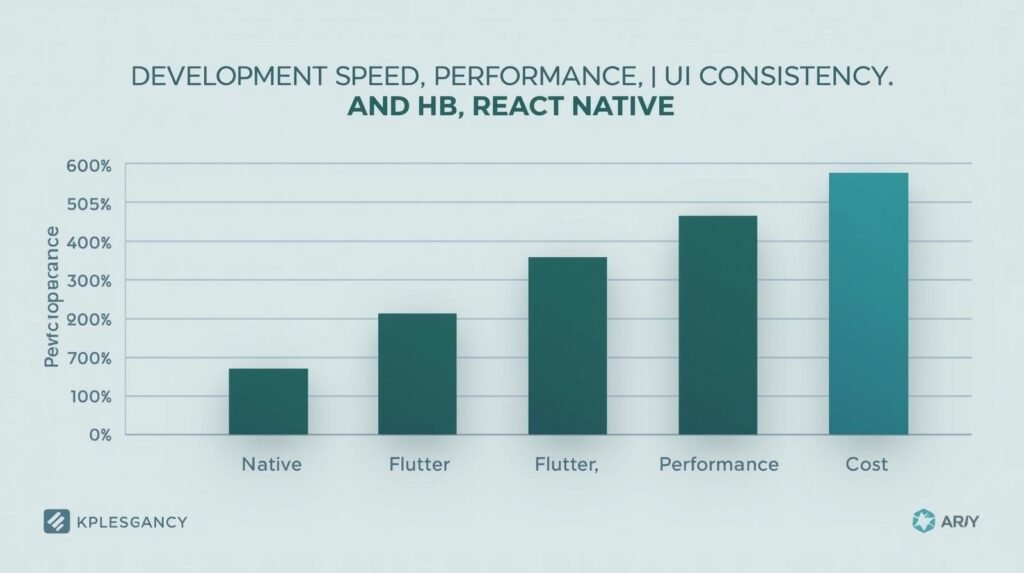
When choosing between flutter vs react native vs native, you must look at the total cost of ownership.
Cross-Platform (Flutter/React Native):
- Upfront: Generally 30% to 40% cheaper than building two native apps. You only need one team of developers.
- Maintenance: Easier. When you want to change a feature or fix a bug, you do it once, and it pushes to both stores.
Native Development:
- Upfront: Expensive. You are essentially paying for two distinct projects.
- Maintenance: More complex. If a bug appears on the iOS version but not Android, you have to diagnose and fix it specifically for that platform.
Performance: Does the “Bridge” Really Matter?
A common criticism of cross-platform apps is that they are “slow.” Five years ago, this was true. Today, for the vast majority of business use cases—dashboards, shopping carts, chat apps, and service marketplaces—the performance difference is negligible.
Unless your app requires millisecond-perfect responsiveness for high-speed data processing or heavy 3D rendering, a well-optimized Flutter or React Native app will perform flawlessly. The “bottleneck” in modern apps is almost always the network (waiting for data from a server), not the language the app is written in.
How to Choose: The Code Nest Decision Framework
If you are unsure which path to take, ask your team these four questions:
- How complex is the UI? If you want a highly custom, brand-focused UI with unique animations that look the same on every device, Flutter is usually the winner.
- What is your existing tech stack? If your internal team is already proficient in JavaScript and React, React Native will get you to market fastest.
- Do you need deep hardware integration? If your app relies heavily on Bluetooth, custom camera filters, or low-level background processing, Native will save you from “integration headaches” down the line.
- What is your timeline? If you need to launch a Minimum Viable Product (MVP) on both stores within 3 months, Cross-Platform is the only viable path.
The Verdict: The Future is Shared
At Code Nest, we see the market moving decisively toward cross-platform solutions for enterprise and startup applications. The efficiency of maintaining a single codebase far outweighs the marginal performance gains of Native for most business applications.
However, we don’t believe in a one-size-fits-all approach. We analyze your feature list and your 2-year roadmap before recommending a stack. Sometimes, a “Hybrid” approach—where the core app is cross-platform but specific high-performance features are written in Native code—is the best of both worlds.
Building a mobile product is a major investment. Don’t let a technical mismatch drain your budget. Contact Code Nest today for a technical consultation to determine if Flutter, React Native, or Native is the right move for your project.
Leave a Reply