
For years, the development community faced a frustrating trade-off. You could build a highly interactive, lightning-fast web application using React, but you would often struggle with Search Engine Optimization (SEO). Because standard React applications rely on Client-Side Rendering (CSR), search engine crawlers often saw a “blank page” before the JavaScript finished loading. In the eyes of Google, if the content isn’t there immediately, it doesn’t exist.
Next.js changed that narrative. By providing a framework that allows for Server-Side Rendering (SSR) and Static Site Generation (SSG), Next.js gives businesses the best of both worlds: the interactive power of React and the searchability of a traditional HTML website.
At Code Nest, we’ve transitioned many of our enterprise and startup clients to Next.js specifically to solve visibility issues. Here is why the nextjs seo benefits make it the gold standard for modern, growth-oriented websites.
The Problem: The “Empty Box” of Standard React
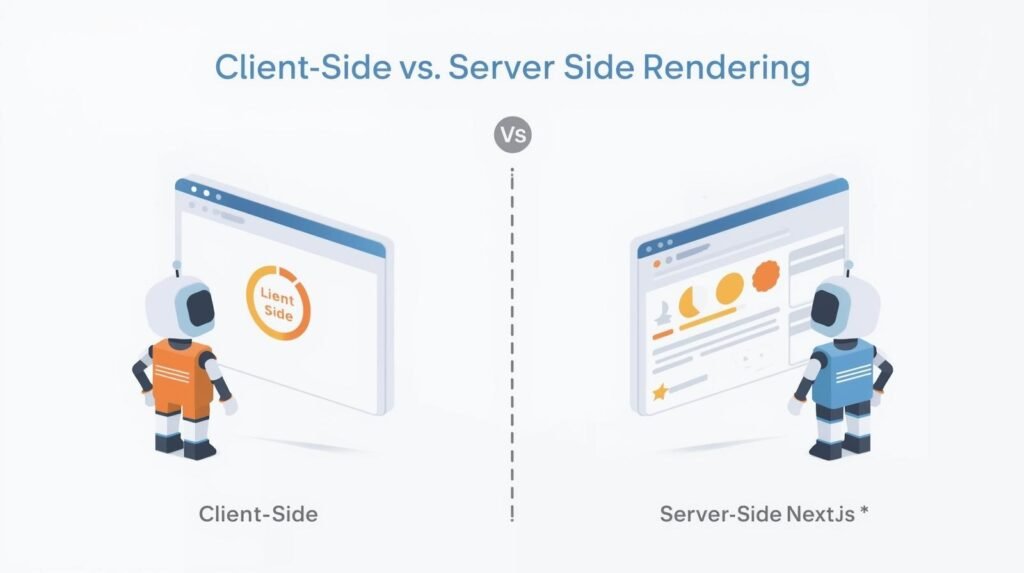
To understand the value of Next.js, you must first understand the flaw in standard React for SEO.
In a traditional React app (Client-Side Rendering), when Google’s bot visits your site, the server sends a nearly empty HTML file and a large bundle of JavaScript. The browser then has to execute that JavaScript to “paint” the content on the screen.
While Google has become better at crawling JavaScript, it isn’t perfect. It often performs a “two-pass” index. The first pass looks at the empty HTML. The second pass (which can happen days or weeks later) looks at the rendered content. For a business that relies on timely content or high-volume organic traffic, this delay is unacceptable.
Next.js solves this by “pre-rendering” the page. When the crawler arrives, the content is already there in the HTML.
1. Server-Side Rendering (SSR) and Static Site Generation (SSG)
Next.js offers two primary ways to deliver content that search engines love:
Static Site Generation (SSG)
With SSG, your website is built into HTML files at “build time.” Think of this as pre-cooking a meal. When a user (or a crawler) requests the page, the server simply hands them a finished file. It is incredibly fast and highly indexable. This is perfect for blogs, documentation, and marketing pages where content doesn’t change every minute.
Server-Side Rendering (SSR)
For pages that need real-time data—like a personalized dashboard or a dynamic price feed—SSR generates the HTML on the server for every request. Unlike standard React, the “work” is done on the server before the data reaches the browser. Google sees a fully formed page every time, ensuring that dynamic content is indexed just as easily as static text.
2. Unmatched Performance and Core Web Vitals
In 2021, Google introduced Core Web Vitals as a major ranking factor. They no longer just care what is on your page; they care how fast it loads and how stable it feels. Next.js is engineered specifically to excel in these metrics.
Automatic Image Optimization
Large, unoptimized images are the #1 reason for slow websites. Next.js includes a built-in Image component that automatically resizes images, converts them to modern formats like WebP, and implements “lazy loading.” This ensures your site doesn’t load a 5MB hero image on a small smartphone screen, keeping your Largest Contentful Paint (LCP) score in the green.
Code Splitting
In a massive website, you don’t want a user to download the code for the “Contact” page when they are only looking at the “Home” page. Next.js automatically splits your code into small chunks. The browser only loads what is necessary for the current page, significantly reducing the “Total Blocking Time” and improving the user experience.
3. The Power of Link Prefetching
Next.js has a “secret weapon” for perceived speed called prefetching. When a user scrolls and a link comes into their viewport, Next.js begins downloading the code for that linked page in the background.
By the time the user actually clicks the link, the page is already in their browser’s cache. The transition feels instantaneous. To Google, this ultra-low latency signals a high-quality user experience, which indirectly boosts your search authority.
4. Simplified Metadata Management
SEO requires precise control over the <head> of your HTML documents—titles, meta descriptions, canonical tags, and Open Graph tags for social media.
In a standard React app, managing these dynamically can be cumbersome. Next.js provides a built-in Head component that allows developers to easily inject metadata into every individual page. This ensures that every blog post and every product page has a unique, optimized title and description that appears correctly in search results.
5. Incremental Static Regeneration (ISR): The Best of Both Worlds
One of the most advanced nextjs seo benefits is Incremental Static Regeneration (ISR).
In the past, if you had a site with 10,000 pages and you updated one, you had to rebuild the entire site. With ISR, Next.js allows you to update specific static pages in the background after you’ve deployed, without needing a full rebuild.
This means you can have the speed of a static site with the flexibility of a dynamic one. Your SEO remains strong because the content is always up to date, and the pages always load instantly.
Is Next.js Right for Your Business?

At Code Nest, we generally recommend Next.js for:
- E-commerce Stores: Where product pages need to be fast and indexable.
- SaaS Marketing Sites: Where lead generation depends on high-ranking educational content.
- Content Platforms: Where performance and SEO are the primary drivers of revenue.
While a simple WordPress site might suffice for a local business, companies looking to scale their digital presence through organic search cannot afford the performance bottlenecks of older frameworks.
Conclusion: Investing in Technical SEO
SEO is no longer just about keywords and backlinks; it is about the technical foundation of your website. Next.js provides a “performance-first” architecture that removes the traditional barriers between React development and search engine visibility.
By utilizing SSR, SSG, and built-in optimization tools, Next.js ensures that your site is fast, accessible, and—most importantly—visible to the people searching for your services.
Are you struggling with poor search rankings on your React-based site? Contact Code Nest today. Our team specializes in Next.js development and SEO migrations to help you capture the organic traffic your business deserves.
Leave a Reply