
Core Web Vitals INP, mobile-first indexing, schema markup benefits, website architecture for SEO, javascript SEO
Introduction
The era of trying to game Google with keyword repetition is gone. AI-driven search systems no longer reward pages just because they mention a phrase twelve times. They reward pages that function flawlessly.
A website is a house. Keywords are the paint. Technical SEO is the foundation. You can repaint endlessly, but if the structure is cracked, the house collapses. In 2025, this analogy has become reality. Google’s ranking systems—reinforced by AI Overviews, UX signals, and quality scoring—prioritize page experience, code stability, and system health before even considering your text.
This is why the technical SEO checklist 2025 matters more than any keyword strategy you’ve used before.

Core Web Vitals Are Now the Law (Not Suggestions)
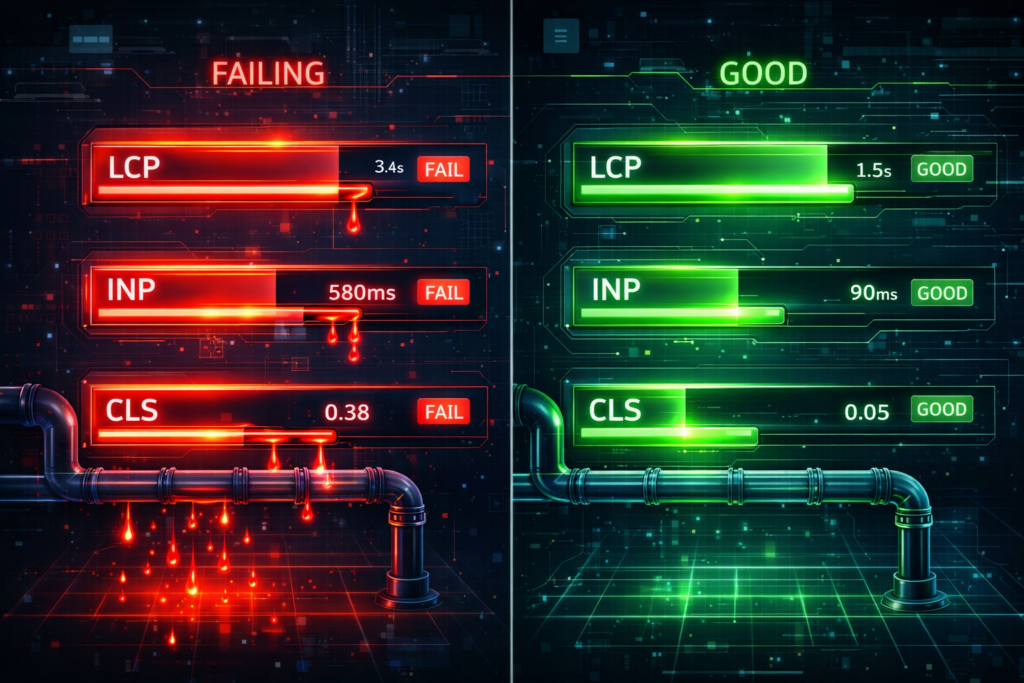
Google’s Core Web Vitals used to be performance recommendations. In 2025, they dictate visibility. If a site consistently fails them, rankings drop aggressively.
The three metrics that matter:
- LCP (Largest Contentful Paint) — Measures how fast the main content appears. If your hero section takes too long, users bounce before they even read the headline.
- INP (Interaction to Next Paint) — This replaced FID and is now the most important interaction metric. It measures how fast the page responds when a user taps, clicks, or types. If a button visually reacts late, users feel the site is broken.
- CLS (Cumulative Layout Shift) — Tracks visual instability. If elements jump while loading, the site feels unreliable.
Google has made it clear with AI Overviews and UX-first ranking models:
If you fail these, you don’t rank. Period.
The shift is logical. As AI answers more queries directly, Google prioritizes sending users only to sites that offer frictionless interaction. Slow loading, lagging buttons, and shifting layouts are treated as trust violations.
Crawl Budget & Architecture: Helping the Bot
Crawl Budget is the number of URLs Googlebot is willing to inspect within a timeframe. Most businesses unnecessarily waste it.
Google doesn’t have unlimited time to understand your website. If your structure is chaotic, pages load slowly, or internal linking is broken, the bot simply stops crawling.
A technically healthy site has:
- A clean architecture with pages organized in silos
- Logical URL hierarchy
- No orphan pages (pages with zero internal links)
- Consistent navigation paths
- No duplicated content generated by sloppy development
Wasted crawl budget means:
- Important pages may never get indexed
- New content takes longer to rank
- Updates are ignored for days or weeks
Messy code amplifies this problem. When the bot encounters unnecessarily large scripts, infinite scroll traps, or recursive redirects, it abandons the crawl. Businesses blame keywords, but the culprit is usually architecture failure.
Speaking “Robot Language” With Schema Markup
Schema markup is structured data that translates your content so AI systems can understand context immediately. It is the difference between Google knowing your page is about “Custom Software Development” versus simply guessing.
Schema powers:
- Rich snippets (stars, FAQs, product prices)
- AI Overview visibility
- Enhanced click-through rates
- Better understanding of services, authors, reviews, and business details
In 2025, Schema has become a core ranking component. Without it, your content is “linguistically flat” to search engines. AI Overviews heavily rely on contextual data, and structured data is the fastest signal.
For modern SEO, Schema is not optional. It’s the language your website must speak if it wants Google to trust it.
The JavaScript SEO Problem
JavaScript frameworks dominate modern development, but most developers still deploy them poorly.
React, Angular, and Vue apps render content on the client side. Googlebot can technically render JavaScript, but it does so slowly and with limitations. Many JS-heavy websites show blank pages during the first crawl.
This is where Code Nest sees the biggest technical failures.
Examples:
- Dev teams ship React SPAs with no Server-Side Rendering (SSR).
- Content loads only after multiple asynchronous calls.
- Routing is virtual, leaving bots unable to map pages.
- Heavy JS bundles delay interaction and inflate INP values.
When Google hits a blank container instead of real content, the page is treated as low-value.
The solution:
Use frameworks like Next.js, which handle SSR and static generation correctly. This ensures:
- Google sees the full HTML instantly
- Content is indexable
- Speed metrics improve
- AI Overviews can extract accurate information
JavaScript SEO in 2025 is a technical discipline, not an afterthought.
The 2025 Technical SEO Checklist (5 Critical Items)
A high-performing website meets these standards consistently.
1. Verify SSL and Security Headers
- HTTPS only
- HSTS enabled
- No mixed content
Security is now a ranking trust signal.
2. Audit Redirect Chains
- Remove chained redirects
- Fix 302s that should be 301s
- Eliminate loops
Redirect issues drain crawl budget and slow page loads.
3. Fix All 404 and Soft 404 Errors
- Real 404s must be resolved or redirected
- Soft 404 pages must return correct status codes
Google punishes sites with unresolved errors.
4. Compress and Modernize Media
- Convert images to AVIF/WebP
- Use responsive image sizes
- Lazy-load non-critical media
Images remain a top contributor to slow LCP.
5. Review robots.txt and XML Sitemaps
- Ensure bots can access key pages
- Remove outdated disallows
- Keep sitemaps clean and up to date
A clear bot path dramatically improves indexing efficiency.
Conclusion
Producing more content cannot fix a broken infrastructure. A website with weak performance, chaotic architecture, or unreadable JavaScript is invisible—no matter how many keywords you target.
Technical SEO has become the determining factor in organic visibility for 2025. Not because keywords are irrelevant, but because Google’s AI systems need technically sound platforms to deliver reliable search experiences.
If your site feels slow, unstable, or inconsistent, Google quietly moves on to a competitor.
Stop guessing. Let Code Nest run a deep-dive Technical Audit on your site today.
Leave a Reply