Introduction
The most common emotional reaction when a merchant first evaluates Shopify Plus is the price jump. You move from roughly $299/month on Advanced to $2,300+/month on Plus. That sparks the predictable question:
“Why would I pay over ten times more for the same platform?”
You’re not paying for a subscription. You’re buying cost savings, checkout control, and operational efficiency at scale. For brands doing seven‑figure revenue, the question is not “Is Plus expensive?” The correct framing is:
“Does Plus save more than it costs?”
For some stores, the math works instantly. For others, the move is premature. The dividing line is not ambition. It’s volume.
Shopify Plus vs Standard: The Transaction Fee Math
This discussion must start with transaction fees because that’s where merchants either justify or kill the upgrade.
On Standard/Advanced, you pay higher payment processing rates and extra fees on external gateways. Plus lowers these rates significantly.
Assume:
- $150,000/month in revenue
- 60% via Shop Pay / credit cards
- 40% via external gateways
A 0.3% – 0.4% difference in fees alone can mean:
- $450 – $600/month savings at $150k revenue
- $900 – $1,200/month savings at $300k revenue
- $1,800 – $2,400/month savings at $500k revenue
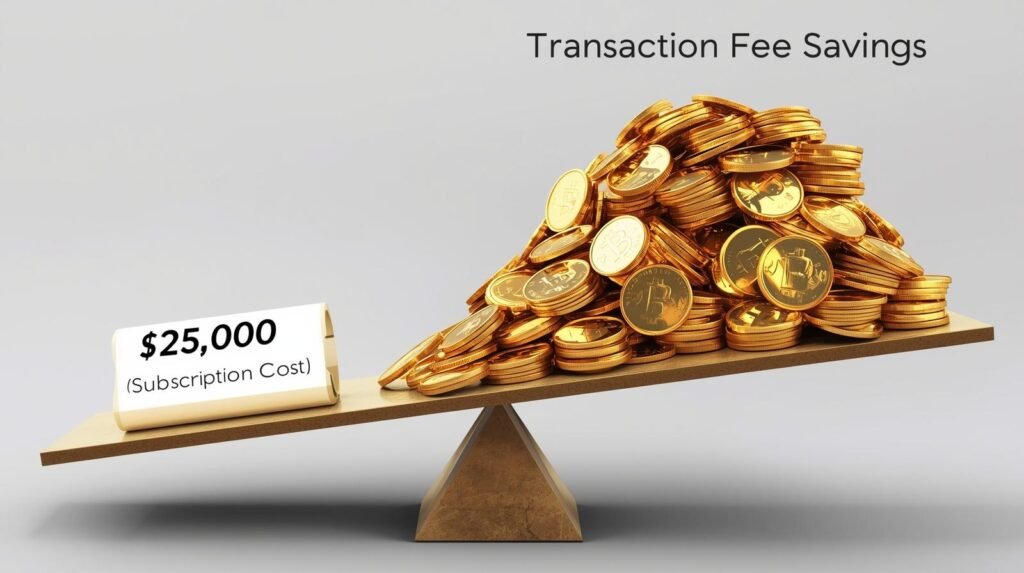
At roughly $500k/month, the fee savings can exceed the entire Plus subscription cost.
This is the pivot most merchants overlook.
Plus can feel expensive at $50k/month revenue.
It becomes functionally free when you cross higher thresholds.
If you rely heavily on external gateways, the breakeven point arrives even faster. Stripe, PayPal, and international payment rails widen the fee gap.
The takeaway is straightforward:
- Sub‑$1M merchants struggle to justify the upgrade.
- $1.5M+ merchants often cover most of the subscription cost through fee reduction alone.
Plus stops being a luxury and becomes a financial hedge against scale.
Checkout Extensibility: The Real Leverage Point
The next question is control. On Standard Shopify, the checkout is locked. You cannot add functionality beyond superficial branding. That limitation forces you to leave revenue on the table.
Plus unlocks Checkout Extensibility—Shopify’s 2025 replacement for the legacy checkout.liquid approach. This upgrade allows:
- one‑click upsells
- address validation
- custom fields
- loyalty modules
- fraud checks
- post‑purchase offers
If your checkout improves conversion from 1.9% to 2.1%, the financial outcome looks like:
- $100k/month → +$2,000/month
- $500k/month → +$10,000/month
- $1.5M/month → +$30,000/month
A fraction of a percentage converts into significant annual impact.
Small brands underestimate micro‑conversion lifts.
Large brands rely on them.
Checkout control isn’t an aesthetic upgrade. It’s a profit function.

B2B and Wholesale: Native vs. Patchwork
Wholesale on Standard Shopify is an exercise in app stacking:
- price lists
- account gating
- tax exemption
- minimum order rules
- net terms
Each component is duct‑taped through third‑party tools. That creates:
- support overhead
- duplicated data
- order syncing problems
- permission conflicts
Plus consolidates wholesale operations:
- dedicated B2B portals
- custom price lists per customer
- volume‑based pricing
- Net 30 payment terms
- restricted product visibility
For merchants with:
- storefront B2C
- wholesale B2B
- international expansion
…the operational savings compound.
Wholesale apps costing $300 – $1,200/month can be retired.
Plus eliminates complexity and reduces errors—something CFOs notice long before CMOs.
Automation and Flash Sales: Where Plus Protects Revenue
Mid‑market brands underestimate the operational cost of manual labor.
Plus includes:
- Shopify Flow (automation)
- Unlimited API calls
- Launchpad for scheduled sales
Examples of automation ROI:
- “Tag VIP customers on orders over $500”
- “Alert fulfillment when stock < 25”
- “Auto‑cancel fraud‑risk orders”
- “Sync ERP inventory without hitting rate limits”
During high‑traffic events like Black Friday:
Standard Shopify stores can throttle.
Plus stores benefit from elevated API limits.
The financial difference is not theoretical. A site crash at $50k/hour throughput is a crisis. Plus safeguards against that risk.
For merchants with ERPs like NetSuite or custom OMS, the unlimited API capacity alone justifies the upgrade.
Multi‑Store and International Operations
Plus allows:
- cloned storefronts
- region‑specific pricing
- local currencies
- language segmentation
- tax overrides
For brands in the US expanding to UK + CA + EU:
Standard Shopify = fragmented tech stack
Plus = centralized control
International commerce is not just checkout. It’s:
- returns
- duties
- VAT
- shipping rules
At scale, these operational layers require more than plugins. They require native control.
The ROI Formula: When the Upgrade Makes Sense
You should not upgrade solely because:
- “Plus is for big brands”
- “Competitors use it”
- “We want a premium platform”
That logic burns cash.
Upgrade when the math aligns:
Do not upgrade if:
- Revenue < $800k/year
- 1 storefront
- No wholesale
- Low external gateway usage
- No custom checkout needs
Upgrade becomes logical when:
- Revenue > $1.5M/year
- Multiple regions
- Wholesale operations
- Subscription products
- High transaction volume
- Conversion‑sensitive funnels
Upgrade immediately if:
- Checkout customization equals measurable ROI
- App costs exceed $1–2k monthly
- Operations require automation
- Manual fulfillment tasks are scaling with headcount
The decision is not emotional.
It is calculable.
Comparing Shopify Plus Features vs Standard (2025 Snapshot)
| Feature | Standard | Plus |
|---|---|---|
| Subscription Cost | ~$299 | $2,300+ |
| Checkout Control | Restricted | Checkout Extensibility |
| Transaction Fees | Higher | Lower |
| Wholesale | Apps required | Native B2B |
| Multi‑Store | Limited | Global storefronts |
| API Limits | Standard | Expanded |
| Automation | Partial | Full Flow + Launchpad |
| Multi‑Currency | Apps | Native |
This is not a feature list—it’s a cost‑reduction list.
Plus trims:
- payment fees
- app fees
- operational labor
- downtime risk
For enterprise e‑commerce, this is infrastructure.
Code Nest Verdict: When Should You Call Us?
For brands at $500k/year, Plus is expensive.
For brands at $1M – $5M/year, Plus is leverage.
If:
- you need checkout customization
- you want to consolidate B2B
- you plan international storefronts
- you rely on automation
- you want to reduce app dependency
…Plus is more cost‑efficient than Standard.
If you’re still below $800k/year, keep operations lean.
Invest in CRO and paid acquisition first.
Upgrade only when it reduces, not increases, cost.
Final Takeaway
Shopify Plus isn’t an aspirational badge. It’s a financial tool.
When the math works, the subscription fee is insignificant compared to savings generated from:
- reduced transaction fees
- checkout conversion gains
- wholesale automation
- app consolidation
- international scaling
If you want to know whether your store is at the breakeven point, Code Nest can run a free ROI calculator using your actual revenue, fee structure, and operational costs.
Leave a Reply