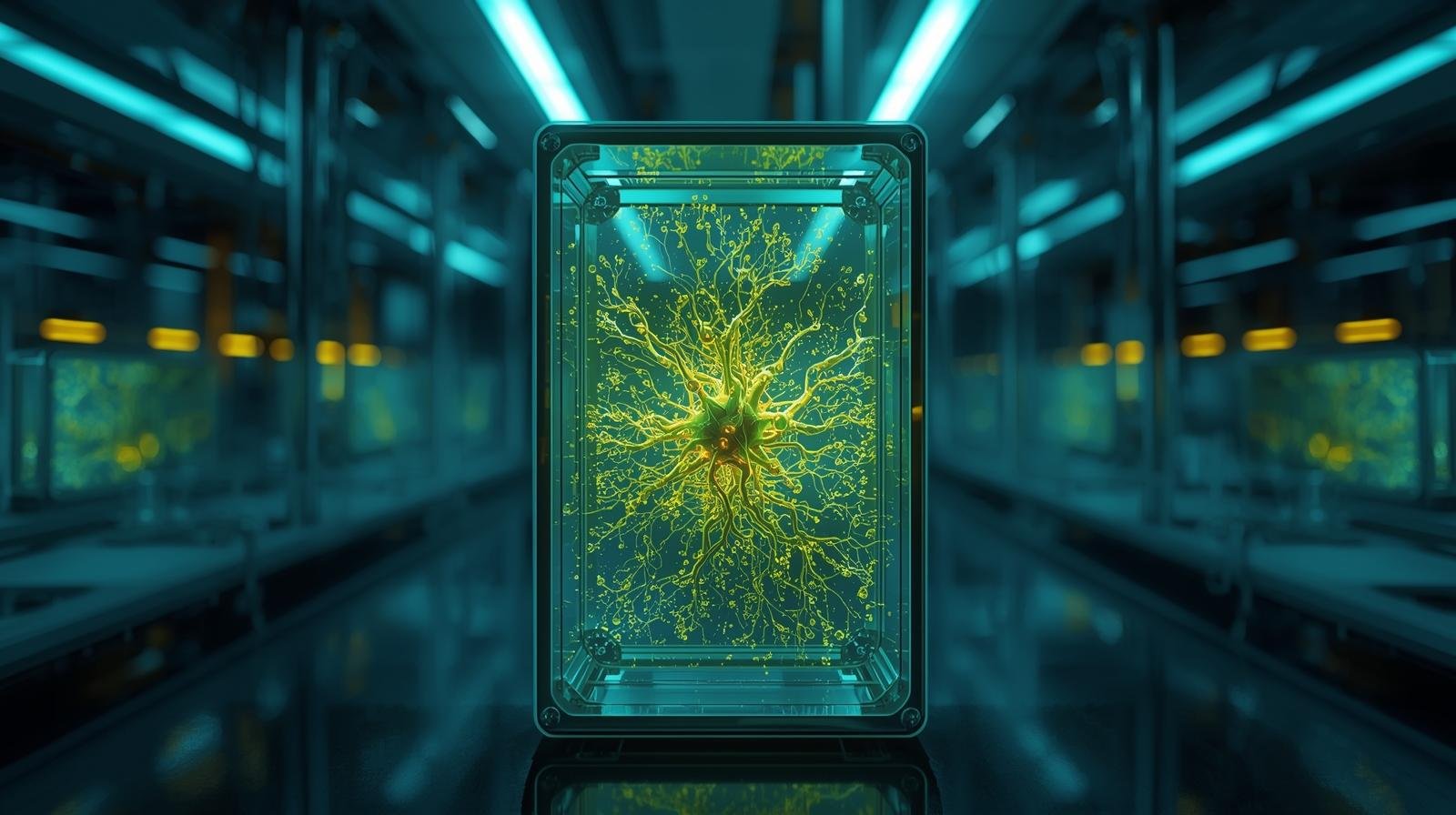
If you think the current AI boom is the peak of human engineering, look inside your own skull. The human brain operates at a staggering 1 exaflop—performing a billion billion calculations per second—yet it runs on roughly 20 watts of power, barely enough to light a dim bulb. In contrast, a silicon-based supercomputer required to match that processing power would consume megawatts of energy and require a dedicated cooling plant.
We have reached the “Silicon Ceiling.” As our demand for data and “Intelligence-as-a-Service” skyrockets, the traditional chip architecture is becoming too hot, too power-hungry, and too physically limited. Enter the world of Bio-Computing.
According to recent data from Grand View Research, the global bio-informatics tech and biocomputing market is projected to grow at a CAGR of 16.5% through 2030. In 2026, we are no longer asking if we can merge biology with technology, but how quickly we can scale it. We are moving from a world of hardware and software to a world of “Wetware.”
1. What is Bio-Computing? (Answering the Search Intent)
One of the most frequent questions on Google today is: “Is bio-computing real or just sci-fi?”
The answer is that it is very real, and it’s currently being deployed in high-level research labs and specialized data centers. Unlike traditional computing, which uses silicon transistors to represent 0s and 1s, bio-computing utilizes biological molecules—such as DNA, RNA, and even living neurons—to store, retrieve, and process information.
In 2026, the bio-informatics tech sector has matured from simple sequencing to “Synthetic Logic.” We aren’t just reading the code of life; we are using that code to build a new type of CPU. Biological computers don’t just “calculate”; they grow, they heal, and they adapt.
Why IT Professionals Should Care:
- Energy Efficiency: Biocomputers could theoretically reduce data center energy consumption by 10,000%.
- Parallelism: Unlike silicon, which processes tasks linearly, DNA molecules can perform trillions of chemical reactions simultaneously.
- Environmental Impact: Bio-based chips are biodegradable, potentially solving the looming e-waste crisis.
2. DNA Data Storage: Nature’s 4.5 Billion-Year-Old Hard Drive
The search intent for “How much data can DNA hold?” reveals a startling statistic: You could theoretically store all of the world’s currently existing digital data in just a few liters of DNA.
Silicon-based storage (HDDs and SSDs) is reaching its physical limits. Data “rot” (bit decay) means we have to migrate our digital archives every decade. DNA, however, is nature’s master archivist. We have successfully sequenced DNA from mammoths that lived hundreds of thousands of years ago.
How it works in 2026:
Using specialized bio-informatics tech pipelines, we translate digital 0s and 1s into the four nitrogenous bases of DNA: Adenine (A), Cytosine (C), Guanine (G), and Thymine (T). To “read” the data, we use high-speed genomic sequencers.
Major tech giants have already begun “Cold Storage” DNA trials for long-term data archival. By 2027, your historical bank records or family photos may not be stored on a server in Virginia, but in a vial of synthetic DNA.
3. Synthetic Biology and the “Living Stack”: Programming with G, C, T, and A
To understand the growth of bio-computing, you have to look at the Bio-Informatics Tech stack. We are seeing a move toward “Biological Programming Languages.”
Just as a developer uses Python or C++, “Synthetic Biologists” use CAD tools to design genetic circuits. These circuits are then “booted up” inside living cells—usually E. coli or yeast—which then execute specific tasks.
Real-World Use Cases in 2026:
- Smart Medicines: Programmable cells that circulate in the bloodstream, detecting cancer markers and releasing a localized payload of drugs only when a specific “logic gate” is triggered.
- Environmental Sentinels: Biological sensors deployed in the ocean that process chemical signals and “report back” data by changing color or emitting bioluminescence.
- In-Memory Processing: Using “Organoid Intelligence” (clusters of lab-grown brain cells) to perform complex pattern recognition tasks that are currently too taxing for standard neural networks.
The barrier to entry for this “Living Stack” has dropped. We now have Bio-Informatics Tech platforms that allow developers to design these cells using a “Drag-and-Drop” interface, effectively turning biology into the ultimate low-code environment.
4. Addressing Search Intent: “Is Bio-Computing Dangerous?”
As interest grows, so does the search volume for ethical concerns. People are asking: “What happens if a biological computer gets a virus?” or “Could a bio-computer become sentient?”
In 2026, we distinguish between Biomimetic Computing (simulating biology on silicon) and Living Computing (using actual cells). The ethical and security frameworks are struggling to keep up.
The Security Risks:
Traditional cybersecurity deals with firewalls and encryption. Bio-computing security deals with Biosecurity. If your computer is living, it is susceptible to mutations, biological viruses, and environmental degradation. Tech leaders must now think about “Physical Guardrails.”
In terms of ethics, “Organoid Intelligence”—using lab-grown human brain cells for computation—has triggered intense debate. The tech community in 2026 is currently establishing a “Hierarchy of Agency” to decide at what point a biological computer gains “rights” or requires a different level of moral consideration.
5. The Bio-Digital Convergence: The Decade Ahead
As we look toward 2030, the line between the silicon world and the biological world will blur. We are moving toward a Hybrid Infrastructure.
Standard servers will handle the fast, everyday transactions (the “System 1” thinking), while bio-informatics tech modules will handle massive, complex simulations and long-term data storage (the “System 2” thinking).
This is not the end of the IT professional; it is the evolution of the role into a “Hybrid Architect.” You won’t just be managing Linux servers; you’ll be managing incubated modules where the “hardware” requires a specific pH level and a nutrient feed to function.
Key Takeaways
- Silicon Efficiency Gap: Bio-computing offers a solution to the unsustainable energy demands of modern AI and data centers.
- The Power of DNA: DNA is the most dense and durable storage medium known to man; it is the future of archival “Cold Storage.”
- Bio-Informatics Tech is the Gateway: Modern tools are allowing developers to treat DNA and cellular logic like code, enabling a “Software-Defined Biology” era.
- Wetware Ethics: “Organoid Intelligence” and cellular programming are the next great frontier of tech ethics and regulation.
- Hybrid Architecture: The next decade will be defined by systems that utilize both silicon chips for speed and biological modules for complexity and memory.
Leave a Reply