
If you feel like the ground is shifting beneath your feet as a junior developer, you aren’t imagining it. According to recent 2025 industry data from Stack Overflow’s Developer Ecosystem Report, while overall demand for software remains at an all-time high, job postings for “traditional” entry-level manual coding roles have dropped by nearly 38% since 2023.
The headlines are provocative: “Coding is Dead,” or “The Death of the Software Engineer.” With AI models now capable of passing Google L3 coding interviews and generating full-stack repositories in seconds, the panic among those just starting their careers is palpable.
But here is the truth that the clickbait won’t tell you: Coding isn’t ending; it’s evolving. We are witnessing the most significant transition in the history of computer science—moving from manual syntax entry to high-level system orchestration. If you want to survive and thrive in the future of programming, you must stop being a “code monkey” and start being an architect.
1. The Paradox of Automation: Why Coding is Dead, but Engineering Lives
To understand your place in the market, you must understand the difference between coding and engineering.
Coding is the act of translating logic into a specific language—Python, Java, or Rust. This is the “translation layer” that AI has successfully commoditized. If your primary value is your ability to remember the syntax for a useEffect hook or a SQL join, you are indeed in competition with an entity that has memorized the entire history of GitHub.
Software Engineering, however, is about problem-solving, trade-off analysis, security, and scalability. AI cannot “want” to solve a business problem. It cannot walk into a stakeholder meeting, understand that the client is actually asking for the wrong feature, and pivot to a more efficient solution.
The future of programming belongs to those who view code as a means to an end, rather than the product itself. In 2026, the junior developer who stays relevant is the one who learns to direct the AI rather than fearing its efficiency.
2. From “Syntactic Experts” to “Context Architects”
If the barrier to entry—writing the code—is lower, then the bar for “excellence” is much higher. In 2026, the market is flooded with functional but mediocre AI-generated code. As a junior developer, your new role is to be the “Validator.”
Understanding the Human-AI Feedback Loop
In the new development workflow, you aren’t staring at a blank screen. You are initiating a feedback loop:
- Context Injection: Feeding the AI the specific business constraints and architecture requirements.
- Logic Review: Analyzing the AI output for “hallucinated” bugs or security vulnerabilities that static analysis tools miss.
- System Integration: Ensuring that the isolated block of code the AI wrote doesn’t break the rest of the microservices.
Search Intent Answer: People are asking “How do I become an AI-driven developer?” The answer is: master the Prompt-to-Code architecture. Learn how to provide specific context—environment variables, security protocols, and latency requirements—within your IDE’s AI agents.
3. The Skill Stack: What You Must Learn Beyond Syntax
To remain relevant in the future of programming, your “skill stack” needs to look very different from a developer in 2019. Here are the four pillars for the 2026 Junior Developer:
A. Deep Domain Knowledge
Anyone can generate a script. Not everyone understands why that script is necessary for a high-frequency trading platform or a healthcare HIPAA-compliant portal. Pick a vertical (FinTech, HealthTech, AI Infra) and learn its laws and logic. A developer who understands the domain is 10x more valuable than one who only knows a library.
B. Security-First Review
AI-generated code is notorious for including insecure dependencies or hard-coded secrets. Junior devs should double down on cybersecurity certifications. Your job is to be the human filter that prevents the next big data breach.
C. Advanced Debugging and Observation
In 2026, we write less and read more. You need to be an expert in “Observable Systems.” Learn to read traces, logs, and telemetry data to find out where a complex AI-generated system is failing.
D. The Human Interface
Soft skills are no longer “nice to have.” As AI takes over the technical grunt work, the “Developer-to-Client” and “Developer-to-User” bridge becomes the bottleneck. Your ability to communicate complex technical constraints to non-technical stakeholders is your greatest defense against automation.
4. The “Great Refactoring”: The Reality of Junior Dev Jobs in 2026
Many juniors ask Google: “Will I even be hired without experience if AI is so good?”
The answer is Yes, but the role looks different. The “junior” of 2026 is essentially what we used to call a “mid-level” developer in 2022. Because AI provides a productivity floor, you are expected to move faster and handle more responsibility.
The era of spending your first six months “fixing CSS bugs” or “writing simple CRUD endpoints” is over. AI does those in seconds. You will be expected to dive into higher-level tasks—API design, data modeling, and UX orchestration—on Day One. This sounds intimidating, but it is actually the most exciting time to be a developer. The “grunt work” has been automated, leaving you with the creative core of building software.
5. Staying Relevant: A Practical 90-Day Plan
If you want to ensure you aren’t left behind by the evolving future of programming, take these steps immediately:
- Stop Memorizing LeetCode: Spend that time learning System Design. Learn how components interact at scale (Load Balancers, Caching, Databases).
- Build an “Agentic” Project: Don’t just build a Todo list. Build an app that uses AI Agents to perform a task (e.g., an agent that researches news and writes a summary report).
- Contribute to Open Source Review: Don’t just push code. Read Pull Requests in major libraries and try to spot logic errors. Train your “Reviewing Eye.”
- Master Local LLMs: Learn how to run and fine-tune small models (like Llama or Mistral) locally on your machine for coding privacy. This is a skill large enterprises are desperate for.
Key Takeaways
- Syntax is Cheap, Solutions are Dear: AI has made writing code a commodity. Providing a bug-free, secure, and business-aligned solution is the high-value skill.
- Engineering vs. Coding: Move from a language expert to a System Architect.
- Security is Your Moat: Junior developers who focus on AI governance and code security are highly protected against replacement.
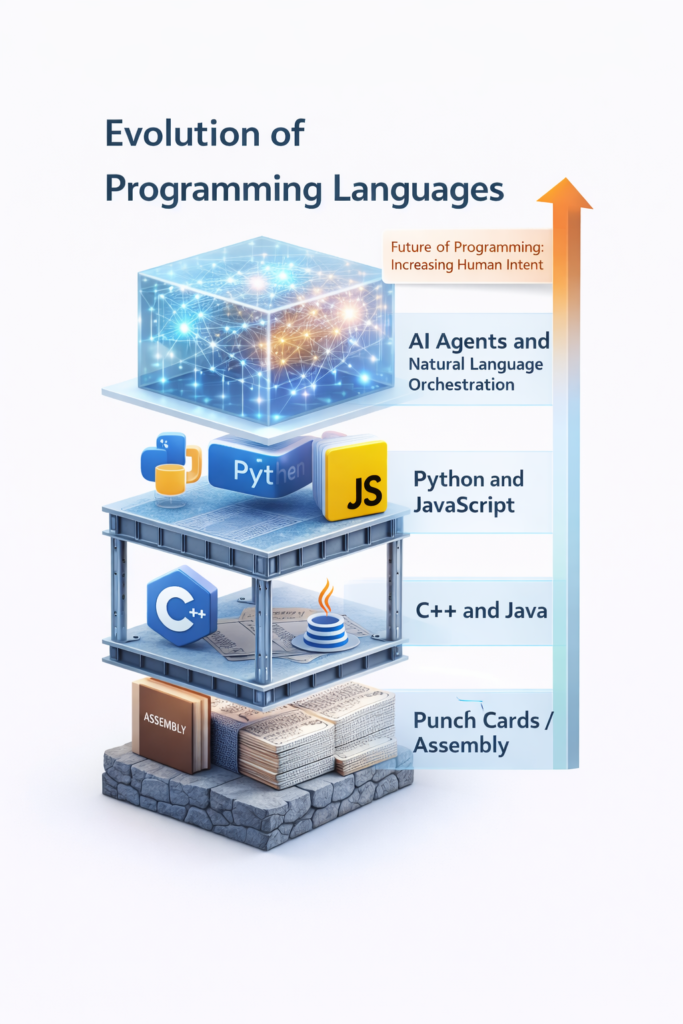
- The Abstraction Shift: The future of programming is just a higher level of abstraction—like moving from assembly to Python. AI is just our new, most powerful “compiler.”
- Domain Expertise is Your Superpower: Know the industry you’re building for better than the AI knows its documentation.
Leave a Reply