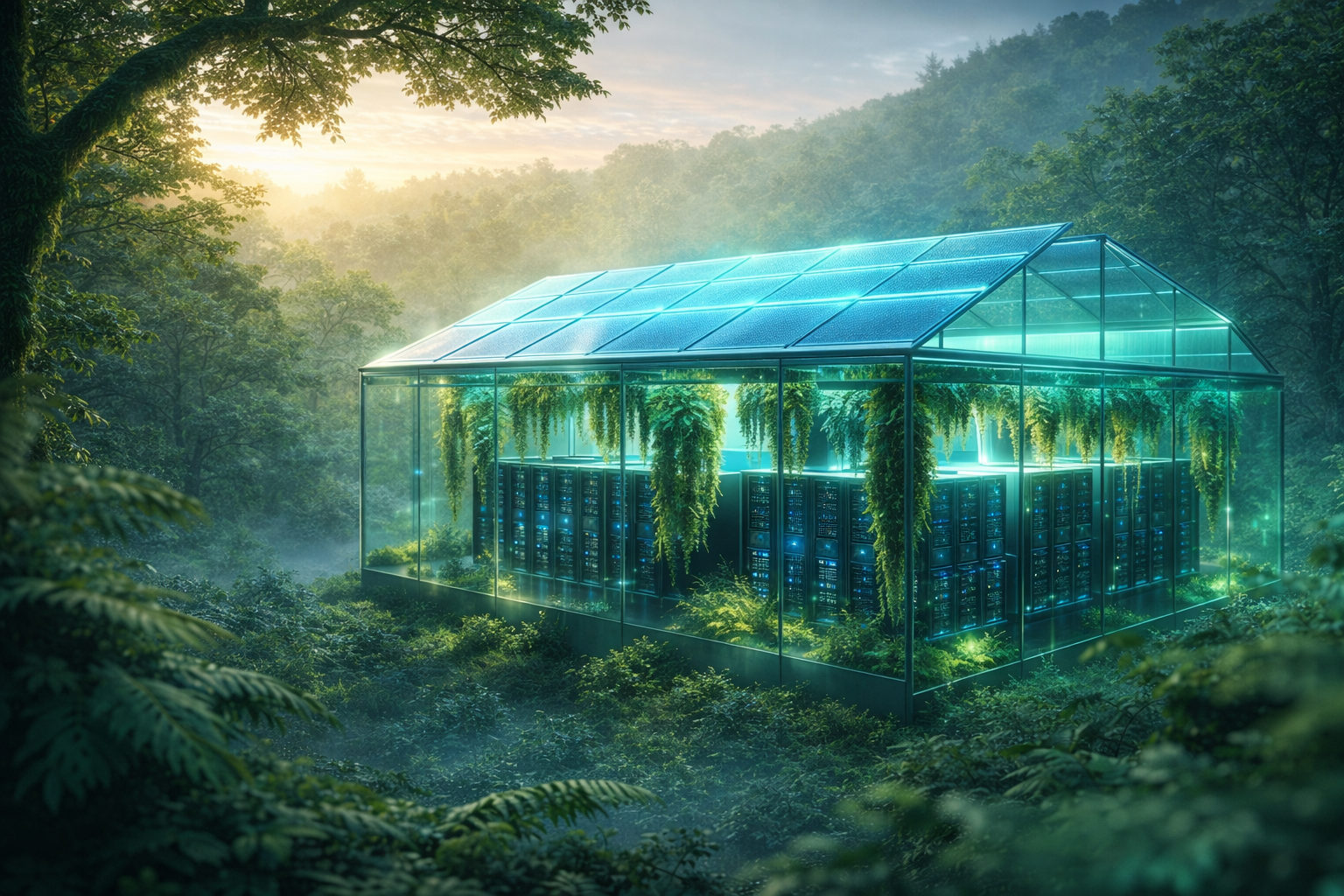
Innovation has always had a shadow. In the 19th century, it was the smog of the Industrial Revolution; in the 21st, it is the staggering energy consumption of the “Intelligence Revolution.” According to recent forecasts from the International Energy Agency (IEA), data centers’ electricity consumption is expected to double by 2026, reaching a level equivalent to the entire power demand of Germany.
As we integrate Large Language Models (LLMs) into every corner of our digital lives, a quiet crisis is brewing. While we marvel at the speed with which an AI can write code or generate art, we often ignore the massive water usage and electrical grid strain required to keep the servers cool and the chips running. In 2026, the tech industry’s biggest challenge isn’t just making AI smarter—it’s making it sustainable.
Can we continue this exponential growth without bankrupting the planet’s climate goals? Here is the deep dive into the AI carbon footprint and the technological breakthroughs striving to make “Green AI” a reality.
1. The Heavy Burden of Inference: Decoding the AI Carbon Footprint
When we discuss the environmental impact of artificial intelligence, public attention usually gravitates toward the training phase. It is well-documented that training a model like GPT-3 produced over 500 metric tons of CO2. However, in 2026, we’ve realized that the “Inference Phase”—the trillions of times users ask AI a question—is the true silent killer.
Training happens once (or periodically), but inference is eternal. Research indicates that up to 60% to 90% of the life-cycle energy consumption of an AI model comes from the usage phase. Every time you ask a chatbot to summarize an email or generate a meme, several grams of CO2 are emitted. Multiplying this by billions of global users daily reveals the staggering scale of the AI carbon footprint.
The Three Layers of Impact:
- Direct Energy Usage: The pure wattage required to power specialized GPUs and TPUs.
- Water Scarcity: Data centers require millions of gallons of water to cool their equipment. Google’s 2023 environmental report showed a 20% spike in water consumption, a figure largely attributed to its AI investments.
- Hardware Lifecycle: The environmental cost of mining the lithium and cobalt required for specialized chips and the e-waste generated by the short lifespan of “cutting-edge” hardware.
2. Model Optimization: Shrinking the Digital Brain
To address search intent regarding “How can we make AI more efficient?”, we must look at model architecture. In the early days of generative AI, “bigger was better.” We believed that the only path to intelligence was adding more parameters. Today, the philosophy has shifted toward “Sustainable Sparsity.”
The Mixture of Experts (MoE) Revolution
Models like Mixtral and GPT-4 use a Mixture of Experts (MoE) architecture. Instead of activating all 100+ billion parameters for a simple query like “What is 2+2?”, the model only “fires” the relevant neurons needed for the task. This makes inference significantly lighter and reduces the energy cost per query by as much as 30% to 40%.
Quantization and Distillation
Engineers are now using a process called Quantization, which reduces the precision of a model’s weights. By shrinking the data from a 16-bit format to an 8-bit or even a 4-bit format, we can fit a powerful model onto a smartphone’s local NPU (Neural Processing Unit). This eliminates the AI carbon footprint caused by transferring data across a global network to a massive centralized server.
3. The Shift to “On-Device” AI: Personal over Cloud-Based
One of the most effective ways to lower the AI carbon footprint is to kill the cloud dependency for minor tasks. In 2026, we are seeing the rise of TinyML and On-Device processing.
Companies like Apple and Qualcomm have released chips capable of running trillions of operations locally without heating up or requiring external power grids. When an AI summarizes a text directly on your iPhone using Apple Intelligence, the energy cost is negligible compared to the “ping-back” required to reach an AWS or Azure data center.
Moving from “Cloud-First” to “Local-First” doesn’t just benefit privacy; it is perhaps the most significant green tech trend of the decade. By utilizing the unused “latent power” of billions of mobile devices, we can decentralize the energy burden that is currently crushing centralized grids in Virginia and Ireland.
4. Green Infrastructure: Can Data Centers Ever Be Truly Neutral?
Even with optimized models, we still need massive data centers. The focus is now shifting toward “Climate-Positive Computing.”
- Siting Based on Renewable Availability: Microsoft and Google are no longer just building data centers near urban hubs. They are building them in regions like Iceland or Scandinavia, where natural geothermal or wind energy is abundant and the cool climate reduces the need for artificial chilling.
- Heat Recovery Systems: New-age data centers in cities like Helsinki are now funneling the excess heat generated by AI servers into the municipal “district heating” systems. Instead of dumping heat into the atmosphere, they are warming the homes of nearby residents.
- Nuclear Small Modular Reactors (SMRs): 2026 has seen the first serious investments from Big Tech into small, dedicated nuclear reactors. While controversial, SMRs provide a carbon-free, “always-on” power source that can keep AI running without destabilizing solar or wind grids during peak demand.
5. Search Intent FAQ: Is AI Truly Bad for the Environment?
Addressing the common questions Google users are asking:
Q: How much carbon does one AI-generated image emit?
A: Estimates suggest that generating one high-quality image with a model like DALL-E uses roughly the same energy as fully charging a smartphone. While small individually, at scale (millions of images per day), the cumulative effect is equivalent to the power of a small city.
Q: Can AI help fix the environment?
A: Paradoxically, yes. This is the “Net Positive” argument. While AI consumes power, it is also being used to design more efficient batteries, optimize shipping routes to reduce fuel, and discover new carbon-capture materials. The goal is to ensure the “Environmental Benefit” of the AI’s output outweighs its “Operational Cost.”
Conclusion: Balancing Progress and Planet
The journey to make AI greener is a race against time. We cannot allow the quest for AGI (Artificial General Intelligence) to come at the expense of our net-zero targets. The good news is that efficiency often leads to better profit—which means tech companies are financially incentivized to make their models “lighter” and “leaner.”
In 2026, the status symbol of a world-class tech company isn’t having the biggest model—it’s having the most “Carbon-Efficient” one. If we continue to lean into local processing, sparse architectures, and heat-recovering infrastructure, we can turn the AI carbon footprint from a crisis into a manageable hurdle on our way to the future.
Key Takeaways
- Inference is the Main Offender: Up to 90% of AI’s energy usage occurs during everyday usage, not just the initial training phase.
- Architecture Evolution: The industry is moving from “dense” models to “sparse” ones like Mixture of Experts (MoE) to save on computational costs.
- The Rise of On-Device AI: Processing AI queries locally on phones and laptops is a primary strategy for reducing grid strain and centralized carbon output.
- Water Usage Matters: AI’s impact is measured in gallons as much as in watts. Innovations in liquid cooling are critical for sustainability.
- Net-Positive Goals: To stay relevant, AI companies must prove their intelligence output contributes to global carbon-reduction solutions that exceed their energy consumption.
Leave a Reply