In many boardrooms, UI/UX design is still viewed as a “finishing touch”—a coat of paint applied to a software product once the “real work” of engineering is complete. This perspective is a costly mistake. When design is treated as an aesthetic luxury rather than a core business strategy, the resulting friction in the user journey leads to abandoned carts, high churn rates, and ballooning support costs.
The ui ux design return on investment is not a vague concept; it is a measurable financial metric. Research from organizations like Forrester has shown that every dollar invested in UX brings a return of up to $100. For a growing business, professional design isn’t about making software look “nice”—it is about removing the barriers between your product and your profit.
Beyond Aesthetics: Defining UI and UX for Business
Before analyzing the financial returns, we must clarify what we are measuring.
- UI (User Interface): This is the sensory layer. It includes the buttons, typography, colors, and spacing. High-quality UI builds brand trust. If a software interface looks dated or cluttered, users subconsciously question the security and reliability of the underlying technology.
- UX (User Experience): This is the structural layer. It is the logic of how a user moves from Point A to Point B. UX is about efficiency. If a user has to click five times to perform a task that should take two, that is a failure of UX that directly translates to lost time and frustration.
At Code Nest, we view UI and UX as two halves of a conversion engine. One attracts the user; the other satisfies them.
1. Reducing Development Rework: The 1:10:100 Rule
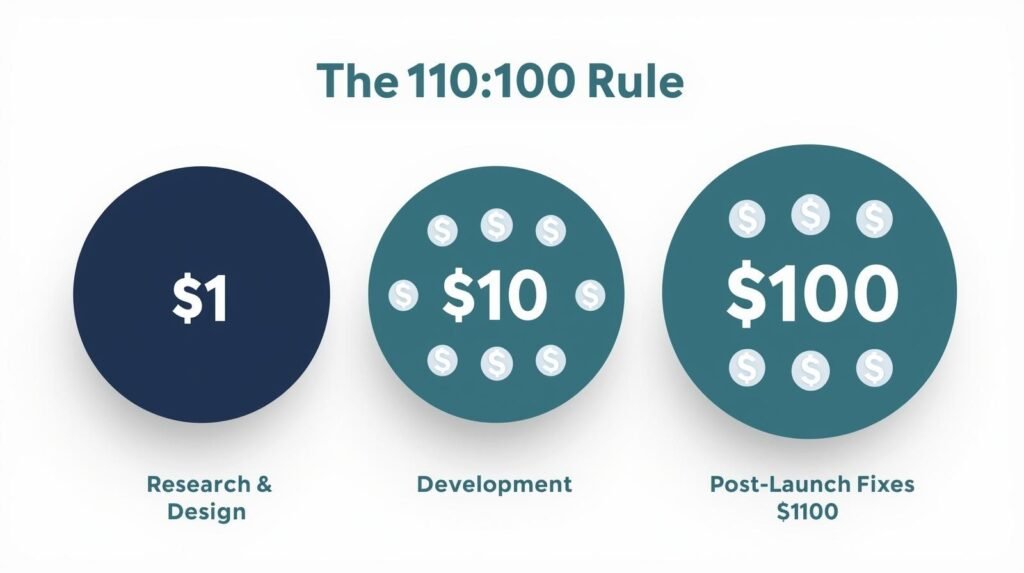
One of the most immediate returns on investment in professional design is the reduction of “technical waste.” In software engineering, there is a well-known principle called the 1:10:100 rule:
- It costs $1 to fix a problem during the research and design phase.
- It costs $10 to fix that same problem during development.
- It costs $100 to fix it after the product has been launched.
When you invest in professional UI/UX design upfront, you are creating a blueprint. Developers don’t have to guess how a feature should work or spend hours rewriting code because a workflow “didn’t feel right” in the final build. A high-fidelity prototype allows you to test logic and user flow before a single line of expensive code is written. This saves weeks of development time and prevents the need for costly “Version 1.1” patches immediately after launch.
2. Lowering Customer Acquisition Costs (CAC)
A common business challenge is driving high traffic to a web or mobile app, only to see a dismal conversion rate. If your marketing (PPC, SEO, SMM) is working, but your sales aren’t, the problem is likely your UI/UX.
Professional design simplifies the path to purchase. By analyzing user behavior, designers can eliminate “friction points”—unnecessary form fields, confusing navigation, or slow-loading elements. According to studies, a well-designed user interface can raise your website’s conversion rate by up to 200%, and a better UX design could yield conversion rates up to 400%.
When your conversion rate doubles, your Customer Acquisition Cost (CAC) effectively halves. That is a direct, bottom-line ROI that scales as your business grows.
3. Increasing Customer Retention and Lifetime Value (LTV)
In the software-as-a-service (SaaS) world, churn is the silent killer. If your software is difficult to use, customers will not stay, regardless of how powerful your features are.
Users today have zero tolerance for complexity. They expect software to be intuitive. If they have to watch a 20-minute tutorial just to understand your dashboard, they will move to a competitor with a cleaner interface.
Professional UX design focuses on “Time to Value”—how quickly a new user can achieve their first “win” with your product. By making the onboarding process seamless and the daily use of the software effortless, you increase user satisfaction. Satisfied users stay longer, refer others, and have a higher Lifetime Value (LTV).
4. Slashing Support and Training Costs
If your support team is overwhelmed with tickets that start with “How do I…” or “Where can I find…”, you don’t have a support problem; you have a design problem.
Intuitive design is self-explanatory. When a system is built with a deep understanding of user psychology, the “next step” is always obvious. For enterprise software, this drastically reduces the cost of training staff. For consumer apps, it reduces the need for a massive customer support department. By investing in UX once, you permanently lower the operational overhead of running your software.
5. Building Brand Equity and Trust
We live in an era of “aesthetic credibility.” Users make a judgment about your business’s professionalism within 50 milliseconds of seeing your interface.
A professional UI signals that your company is established, detail-oriented, and stable. This is particularly crucial for startups or B2B companies handling sensitive data. If the design is polished and the interactions are smooth, the user feels safe. That trust is an intangible but vital asset that makes every other part of your business—from sales calls to fundraising—significantly easier.
How to Measure Your Design ROI
To see the real-world impact of your UI/UX investment, track these four Key Performance Indicators (KPIs):
- Conversion Rate: The percentage of users who complete a desired action (sign-up, purchase, etc.).
- Support Ticket Volume: Are users calling for help because they are confused by the interface?
- Drop-off Rates: At which specific screen or step do users leave the application?
- Task Completion Time: How long does it take for a user to accomplish a core task? (Lower is almost always better).
Conclusion: Design is a Business Decision
The evidence is clear: companies that prioritize design outperform their competitors by a significant margin. The ui ux design return on investment manifests as faster development cycles, lower acquisition costs, and higher customer loyalty.
At Code Nest, we don’t just “draw screens.” We build strategic interfaces designed to solve business problems and drive revenue. We understand that every pixel must serve a purpose and every interaction must move the needle for your bottom line.
Is your software’s design holding back your growth? Contact Code Nest today for a UI/UX audit. Let’s transform your product into a high-converting, user-centric asset.
Leave a Reply