
The temptation is easy to understand. As a business owner, you are constantly approached by “consultants” or agencies offering SEO services for $100, $200, or $500 a month. These offers often come with bold promises: “Guaranteed Page 1 Rankings,” “Thousands of Backlinks,” and “Instant Results.”
If you are running a business with a tight budget, these price points seem like a steal compared to the fees charged by high-tier digital agencies. But in the world of search engine optimization, the old adage remains undefeated: you get exactly what you pay for.
At Code Nest, we are often hired not to build an SEO strategy from scratch, but to perform “emergency surgery” on a website that has been devastated by a budget provider. By the time we get the call, the client has already lost thousands in potential revenue and spent months in digital invisibility.
Understanding the risks of cheap seo services is the first step toward building a sustainable, high-growth marketing strategy.
The Mathematical Impossibility of “Cheap” SEO
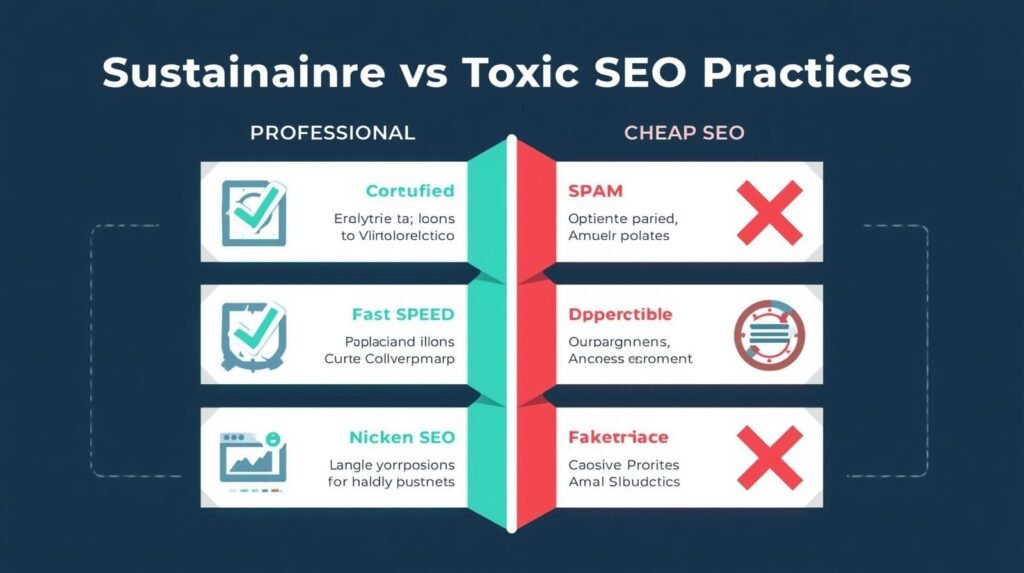
Let’s look at the business logic behind a $200-a-month SEO package. Real, professional SEO requires multiple skill sets: technical developers for site architecture, data analysts for keyword research, expert copywriters for content, and PR professionals for link acquisition.
A quality, 1,000-word article written by a subject matter expert can cost $150 to $300 alone. A technical audit performed by a senior architect takes several hours of high-value labor.
If an agency is charging $200 for the entire month, they cannot afford human expertise. Instead, they rely on automation, offshore “link farms,” and low-quality, AI-generated content. You aren’t buying a strategy; you are buying a shortcut. And shortcuts in the eyes of Google are often seen as violations.
1. The Risk of Permanent Search Engine Penalties
Google’s algorithms are more sophisticated than ever. They are designed to reward helpful, high-quality websites and punish those trying to game the system. Cheap SEO providers often utilize “Black-Hat” tactics to get quick spikes in rankings.
These tactics include:
- Buying Toxic Backlinks: Placing your website link on hundreds of low-quality, spam-filled sites.
- Keyword Stuffing: Overloading your pages with repetitive terms to the point of unreadability.
- Private Blog Networks (PBNs): Artificial webs of websites created solely to manipulate search rankings.
Google’s response to these tactics is swift and brutal. Your site can be hit with a Manual Action, effectively removing your business from search results entirely. Recovering from such a penalty is an expensive, grueling process that can take six months to a year. For most businesses, disappearing from Google for six months is a fatal blow.
2. Low-Quality Content: Damaging Your Brand Identity
In a “cheap SEO” model, content is treated as a commodity, not a conversion tool. These agencies often churn out repetitive, nonsensical blog posts that offer no value to your readers.
Content is the primary way your brand builds trust with a potential customer. If a user clicks on your site and finds poorly written, grammatically incorrect, or unhelpful content, they will leave immediately. This not only destroys your conversion rate but also increases your “Bounce Rate”—a signal to Google that your site is not worth recommending to others.
At Code Nest, we treat content as your “Digital Salesperson.” It should be authoritative, insightful, and designed to move a lead through the sales funnel. Budget providers produce content for bots; professional agencies produce content for people.
3. The Structural Toll: “Dirty” Code and Technical Debt
SEO isn’t just about keywords; it’s about site architecture. Low-cost providers often don’t have the technical expertise to optimize your server settings, JavaScript files, or site speed. Instead, they might install dozens of heavy, poorly coded “SEO plugins” to do the work for them.
Over time, this creates “Technical Debt.” Your site becomes slow, bloated, and vulnerable to security breaches. By the time a professional team arrives, the site’s foundation is so cluttered with bad code and unnecessary scripts that a total rebuild is often the most cost-effective solution.
4. Measuring the Wrong Things (Vanity Metrics)
Budget agencies are experts at distraction. Because they cannot deliver a real Return on Investment (ROI), they focus on “Vanity Metrics.”
They might show you that you are ranking #1 for a specific keyword that has zero search volume. Or they might report on “Total Impressions,” even if none of those impressions led to a phone call or a purchase.
Real SEO is about revenue. A professional b2b digital marketing strategy focuses on high-intent keywords—terms your customers use when they are actually ready to buy. Cheap SEO is like buying a billboard in a forest; it doesn’t matter how pretty it is if nobody sees it, and it certainly doesn’t matter if it’s positioned in front of people who don’t buy your product.
5. The True Cost of “Start Over”
The greatest risk of cheap SEO services is the opportunity cost. If you spend 12 months with a budget agency, you haven’t just lost your monthly retainer. You have lost 12 months of compounding organic growth that your competitors have claimed.
When you eventually hire a professional agency to fix the mess, the “entry fee” is significantly higher. The new agency has to perform a toxic backlink audit, disavow spam links, fix the broken technical foundation, and replace “filler” content with high-quality assets. You end up paying double or triple what it would have cost to do it right the first time.
How to Spot a “Cheap” Agency Trap

If you are evaluating SEO providers, look out for these red flags:
- Guarantees: No one can “guarantee” a #1 ranking. Google’s algorithm is a black box that changes hundreds of times a year.
- Bulk Link Offers: If they mention a “package” for 500 links, run away. High-quality link acquisition is a slow, manual outreach process.
- Lack of Transparency: If they won’t tell you exactly what they are doing on your site, they are likely using automated tools they don’t want you to see.
- No Discovery Phase: A real SEO strategy starts with a deep dive into your business, your competitors, and your sales goals. If they start “doing SEO” without understanding your market, they are using a template.
Conclusion: Value-Driven SEO
Search engine optimization is not an expense to be minimized; it is a capital investment. When done correctly, it is the most powerful engine for long-term, compounding business growth.
At Code Nest, we don’t offer “$99 specials.” We provide deep-form, technical SEO and authority-building content that positions your brand as a leader. We believe that if you’re going to compete on the world’s most crowded stage—the Google search results page—you need an elite team behind you.
Tired of promises that lead to nowhere? Contact Code Nest today for a transparent, data-driven SEO audit. Let’s build a foundation that generates real revenue for the long haul.
Leave a Reply